

TL;DR:
Reducing trading errors depends on structural systems like checklists, risk limits, and automated tools.
Targeting top errors with barriers and reviewing them within 30-day cycles produces measurable progress.
Manual trading errors are defined as any deviation from your documented trading plan during execution, risk management, or position sizing. Knowing how to reduce trading errors is the difference between a trader who compounds gains and one who gives them back. The core tools are pre-trade checklists, daily loss limits, and structured journaling. Research shows that traders using a pre-trade checklist improve consistency by 23% and avoid up to 90% of preventable bad trades. That number alone makes the case for building systematic habits before you place a single order.
How to reduce trading errors with checklists and structured routines
A documented pre-trade checklist is the single most effective tool for trading error prevention. It forces you to slow down and engage what behavioral economists call System 2 thinking: deliberate, rule-based reasoning rather than gut reaction. Without a checklist, you rely on memory and mood. Both fail under pressure.
A practical 7-point pre-trade checklist covers:
-
Market context: Is the broader trend aligned with your setup?
-
Setup validity: Does the pattern meet every criterion in your trading plan?
-
Entry trigger: Has the exact trigger fired, not just a partial signal?
-
Stop loss placement: Is the stop at a logical level, not a round number?
-
Position size: Is risk capped at your predetermined percentage per trade?
-
Risk/reward ratio: Does the trade meet your minimum threshold?
-
News check: Are there scheduled announcements that could distort the move?
Checklists also work during and after a trade. An in-trade checklist prevents premature exits and stop loss violations by giving you a structured reason to hold or exit. A post-trade checklist reviews whether you followed the plan, not whether you made money. Grading process adherence rather than outcomes is what reduces error recurrence over time. Winning on a bad process is noise. Losing on a good process is data.
Pro Tip: Print your checklist and keep it next to your monitor. Digital checklists are easy to skip. A physical card forces a physical action, which interrupts autopilot execution.

You can find detailed guidance on building these routines in this stepwise trade execution guide, which covers how to structure each phase of a trade from setup to exit.
How do risk management rules like daily loss limits reduce costly trading errors?
Daily loss limits are the most underused risk control in retail trading. A daily loss limit is a hard stop on your total account drawdown for the session. Once you hit it, you stop trading for the day. No exceptions.
Here is how to implement a daily loss limit in four steps:
-
Set the threshold. A common benchmark is a 3% daily loss limit. On a $50,000 account, that means you stop trading after a $1,500 loss. This figure comes from risk management research at TradeZella, which identifies this level as effective at preventing revenge trading.
-
Automate the enforcement. Set a platform alert or automated stop at your daily limit. Do not rely on willpower to walk away after a loss.
-
Keep risk consistent across all trades. Traders frequently increase position size when they feel high conviction about a setup. This is a critical error. Conviction is not data; risk must stay constant across all valid setups.
-
Log every breach. If you ever override your daily limit, record it immediately in your journal. Patterns of override are the clearest signal that your rules need structural enforcement, not just better intentions.
Daily loss limits do more than protect capital. They break the feedback loop of revenge trading, where one loss triggers a larger, emotionally driven trade that compounds the damage. Stopping the session removes you from the market before that loop starts.
Pro Tip: Set your daily loss limit alert at 80% of your threshold, not 100%. That early warning gives you time to close positions deliberately rather than hitting the hard stop mid-trade.
For a deeper look at building the rule structure around these limits, the trading rules essentials guide covers how to document and enforce risk parameters across your full trading plan.
How to use trading journals effectively to catch errors and improve discipline
A trading journal is only as useful as the speed and honesty with which you complete it. Journal entries completed within 1 hour of a session capture accurate emotional states. Delays cause what researchers call narrative decay: you rewrite the story of the trade in your memory, smoothing out the panic or overconfidence that actually drove your decisions.
Every journal entry should include:
-
Entry and exit prices with timestamps
-
Setup description and whether it matched your criteria exactly
-
Emotional state at entry: calm, anxious, overconfident, distracted
-
Rule compliance score from 1 to 10 for that specific trade
-
Violation log entry if any rule was broken, with a note on the consequence
The compliance score is the most powerful element. It shifts your focus from profit and loss to process quality. Over time, you will see that high compliance scores correlate with better outcomes, even when individual trades lose.
The table below shows a simple journal review structure:
| Review frequency | Focus area | Output |
|---|---|---|
| Daily (within 1 hour) | Emotional state, rule compliance per trade | Violation log update |
| Weekly | Error patterns, compliance score trends | Top 3 errors identified |
| Monthly | Correction effectiveness, net error reduction | Updated trading rules |
Automating raw execution data capture reduces burnout and keeps your journaling focused on the elements that matter: deviations from plan and emotional state. Tools that pull trade data directly from your broker via API mean you spend your energy on analysis, not data entry. Tickerly’s journal automation guide explains how to set this up without technical complexity.
What are effective methods for analyzing errors and creating external barriers?
Identifying errors is not the same as fixing them. Most traders read their journal, feel bad about a mistake, and then repeat it. The reason is simple: they rely on willpower to change behavior. Willpower is unreliable under stress. External barriers are not.
An external barrier is a structural change that makes rule-breaking difficult or impossible. Effective traders create external barriers like locking accounts, disabling trading during specific hours, or requiring a mandatory wait before execution. These are not punishments. They are system design.
The comparison below shows the difference between intention-based and barrier-based error correction:
| Approach | Method | Reliability |
|---|---|---|
| Intention-based | Promising yourself not to overtrade | Low. Fails under emotional pressure. |
| Barrier-based | Disabling trading after daily limit is hit | High. Removes the option entirely. |
| Intention-based | Remembering to check news before entry | Low. Skipped when excited about a setup. |
| Barrier-based | Mandatory 10-second pause before execution | High. Interrupts impulse before it executes. |
The 10-second stillness pause before execution is one of the most effective barriers available. You sit still, breathe, and ask whether you would take this trade if you had no position on. If doubt remains after 10 seconds, you do not trade. This single habit interrupts emotional impulses that checklists alone miss.
When analyzing which errors to fix first, focus on your top 3 highest-costing errors over a 30-day cycle. Trying to fix everything at once leads to burnout and no measurable progress. Fix one error, measure the result over 20 to 30 trades, then move to the next.
Pro Tip: After identifying your top error, write a single sentence describing the exact moment it occurs. “I enter before the candle closes when I feel I’m missing the move.” Specificity makes the barrier design obvious.
What common pitfalls delay reducing trading errors?
The most common mistake traders make when working on error reduction is confusing intention with action. Writing “I will not revenge trade” in a journal is not a correction. It is a wish. A correction is a structural change you can verify.
Watch for these specific traps:
-
Accumulating errors without segmentation. Reviewing a list of 15 different mistakes creates paralysis. Segment errors by type and cost before you analyze them.
-
Delaying analysis. Reviewing last month’s trades next month means your emotional memory is gone. The analysis becomes intellectual rather than visceral, and the lessons do not stick.
-
Emotional self-judgment. Labeling yourself as “undisciplined” or “impulsive” is not analysis. It is noise. Describe the specific behavior and the specific trigger instead.
-
Skipping verification. After implementing a correction, traders often assume it worked without checking. Measure compliance over the next 20 trades before declaring the error fixed.
-
Premature rule changes. A losing streak of 5 trades is not evidence that your rules are wrong. Changing rules based on small samples creates instability and new errors.
Sustainable progress on minimizing trading mistakes comes from treating your trading process like a system under continuous improvement, not a personality flaw to overcome. Each error is a data point. Each correction is a hypothesis. Test it, measure it, and move forward.
Key takeaways
Reducing trading errors requires structural systems, not willpower: checklists, hard risk limits, timely journaling, and external barriers work together to build consistent, measurable improvement.
| Point | Details |
|---|---|
| Use a 7-point pre-trade checklist | Structured checklists improve consistency by 23% and prevent up to 90% of avoidable bad trades. |
| Set and enforce a daily loss limit | A 3% daily loss cap stops revenge trading before it compounds account damage. |
| Journal within 1 hour of each session | Delays cause narrative decay; immediate entries capture accurate emotions and rule compliance. |
| Build external barriers, not intentions | Structural blocks like timed trading bans are more reliable than willpower under pressure. |
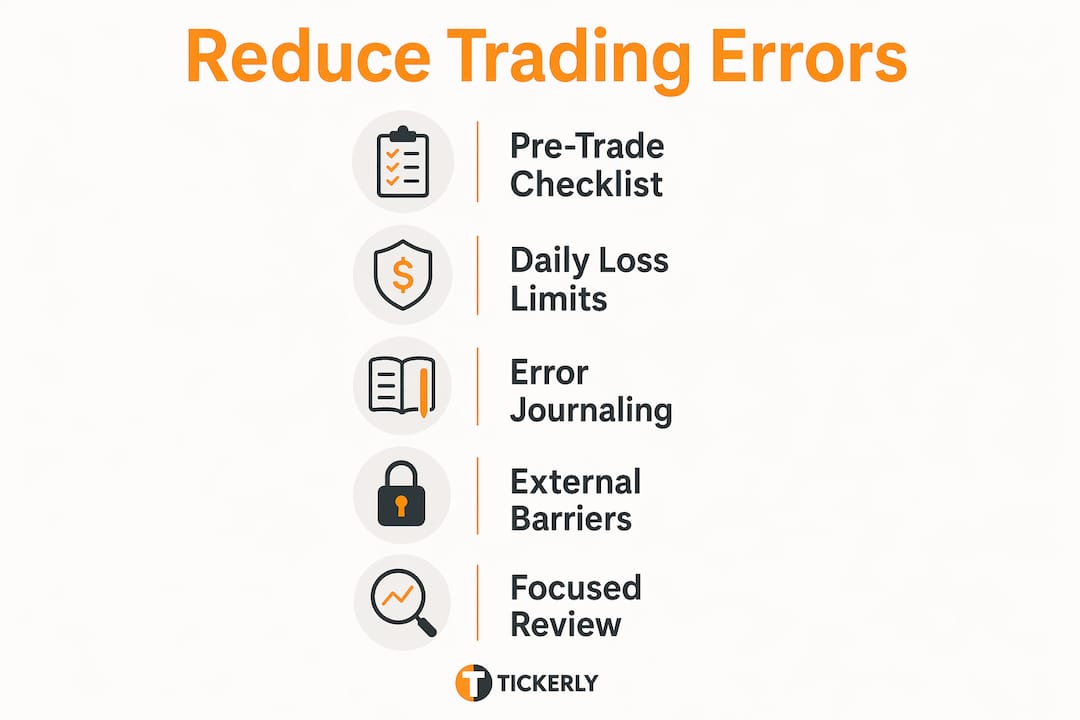
| Fix your top 3 errors per 30-day cycle | Targeting the highest-cost mistakes sequentially prevents burnout and produces measurable results. |
Why I think most traders fix the wrong thing first
The shift that actually moves the needle is grading your process, not your profits. When I started scoring every trade on rule compliance from 1 to 10, I stopped caring whether the trade made money. I cared whether I executed the plan. That reframe changed everything. A 10/10 trade that loses is a good trade. A 3/10 trade that wins is a problem you got away with.
The other thing I have found is that automation removes a category of errors entirely. When your TradingView strategy fires an alert and Tickerly executes it without you touching a button, you cannot second-guess the entry. You cannot widen the stop because you feel nervous. The system follows the rules you set when you were calm, not the rules you feel like following when the market is moving fast. That is not laziness. That is good system design.
Start with your checklist. Add your daily loss limit. Journal the same day. Then look at your top error and build one barrier against it. Do that for 90 days and your trading will look different.— Jay
How Tickerly helps you enforce trading rules automatically
Manual trading puts every rule at risk the moment the market moves against you. Tickerly converts your TradingView strategies into automated bots that execute with speed and consistency, removing the human hesitation that causes most execution errors.

Tickerly connects directly to major exchanges via API, so your pre-defined entry, exit, and position sizing rules execute exactly as written. You set the rules when you are calm and analytical. The bot follows them when the market is volatile. Traders using automated bots for error prevention report fewer execution mistakes and more consistent adherence to their risk parameters. If you want to see how automation fits your current strategy, the automated trading FAQ covers the most common setup questions in plain language.
FAQ
What is the fastest way to reduce trading errors?
Implement a 7-point pre-trade checklist and a daily loss limit immediately. Research shows these two tools alone prevent up to 90% of avoidable bad trades.
How often should I review my trading journal?
Review your journal within 1 hour of each session for emotional accuracy, then conduct a deeper weekly review to identify error patterns across multiple trades.
Why do traders keep repeating the same mistakes?
Repeated errors persist because traders rely on willpower rather than structural barriers. External barriers like account locks or timed trading bans are more reliable than mental discipline under stress.
How many errors should I try to fix at once?
Focus on your top 3 highest-cost errors per 30-day cycle. Attempting to fix all errors simultaneously causes burnout and produces no measurable improvement.
Does automation actually reduce trading errors?
Yes. Automated execution removes the human decision point at entry and exit, which is where most execution errors occur. Platforms like Tickerly execute your TradingView strategy rules without emotional override.