

Most traders think of a trading platform as a simple order window — a place to click “buy” or “sell” and wait for results. That view leaves enormous potential on the table. Modern trading platforms are sophisticated systems that integrate real-time data feeds, risk management tools, alert functionality, and strategy automation capabilities. If you’re using TradingView to build and backtest strategies, the platform you connect to determines how effectively those strategies translate into real market results. This guide clarifies what trading platforms actually do, compares manual and automated workflows, and shows you exactly how platform choice shapes your automation success.
Table of Contents
-
How trading platforms elevate automated strategies with TradingView
-
Why most traders underestimate the power of the right platform
-
Take your TradingView automated strategies further with Tickerly
Key Takeaways
| Point | Details |
|---|---|
| Platform definition clarified | Trading platforms are often broker-supplied software for market access, research, and order execution in some cases. |
| Automation’s platform features | Order speed, integration, and data access are critical for automated strategy success. |
| Manual vs. automated workflows | Platforms cater to both trading styles with distinct features for each. |
| TradingView strategy potential | Integrated platforms make TradingView automation more effective, reducing bias and improving efficiency. |
| Impact of choosing the right platform | Selecting a suitable platform affects execution reliability, risk management, and automated trading outcomes. |
What is a trading platform?
The term “trading platform” gets used loosely, so let’s nail down a precise definition. As Investopedia explains, a trading platform is software provided by a broker (or other market participant) that gives traders access to trading markets and tools to research prices and execute orders.
That definition covers the basics, but modern platforms do far more than that. Think of them as the operational backbone of your entire trading workflow. They handle live price feeds, margin calculations, position tracking, order routing, and increasingly, automated strategy execution through API connections.
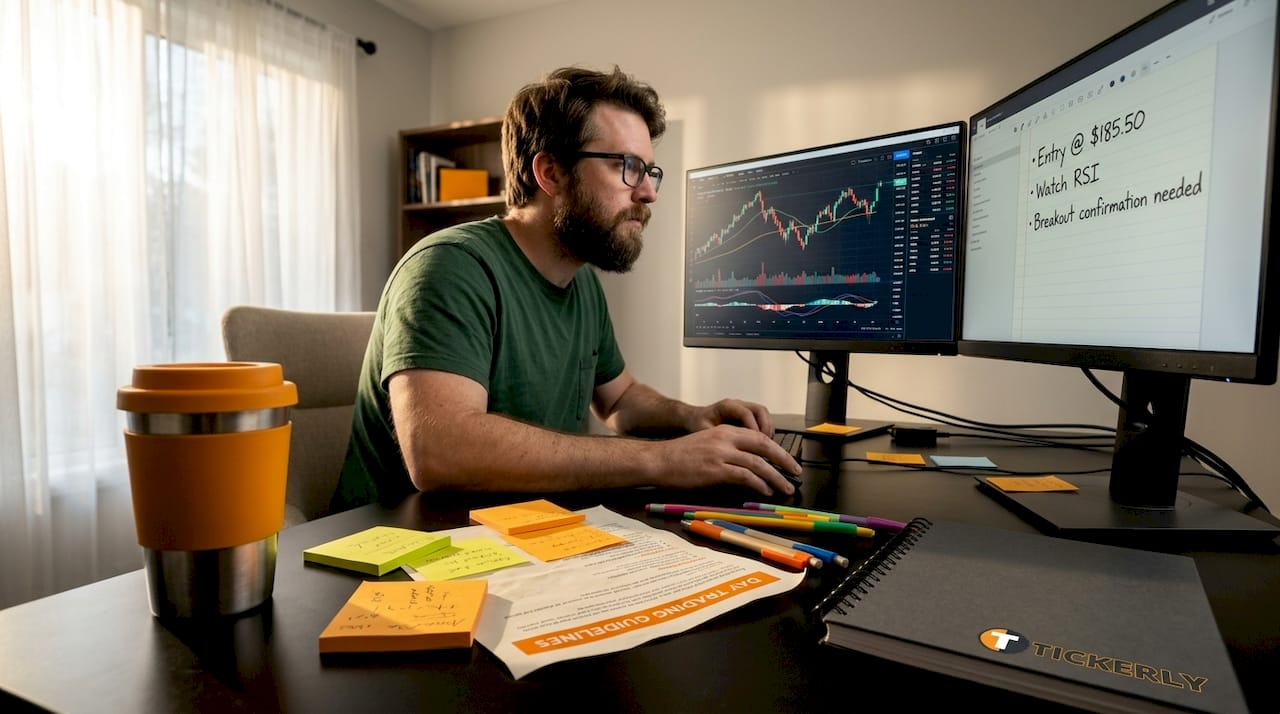
The critical word here is software. Unlike a physical exchange where humans match orders face to face, a trading platform is a programmatic layer sitting between you and the market. Every instruction you give — whether typed manually or sent by an automated system — passes through platform logic before it reaches the exchange or liquidity pool.
For TradingView users specifically, this matters enormously. TradingView is where you write Pine Script strategies, run backtests, and generate trading signals. But TradingView itself does not execute live trades on most brokers without a connected platform. The platform bridges the gap between your strategy logic and actual market execution. Understanding bot trading at a foundational level starts with understanding this bridge.
“A trading platform is software provided by a broker (or other market participant) that gives traders access to trading markets and tools to research prices and execute orders.” — Investopedia
There are two broad categories of trading platforms worth distinguishing. Proprietary platforms are built and maintained by individual brokers, often with tightly controlled features tailored to their asset classes. Third-party platforms are standalone systems that connect to multiple brokers and exchanges, offering greater flexibility. For automation purposes, third-party compatibility is usually what determines whether your TradingView strategy can run hands-free.
Key features of trading platforms for automation
Now that we know what trading platforms are, let’s break down their key features for automation-focused traders. Not all platforms are created equal, and knowing what to look for saves you from costly mismatches between your strategy requirements and platform capabilities.
As noted in established trading literature, trading platforms act as portals to access and manage trading accounts, place orders, and perform related account and trade functions. For automated trading, that functionality needs to extend well beyond basic order placement.
Here are the features that matter most when evaluating platforms for TradingView automation:
-
Execution speed and low latency: Automated strategies live and die by milliseconds. A platform with high latency can cause your orders to fill at unfavorable prices, especially in volatile markets or during high-frequency signal delivery. Look for platforms with direct market access (DMA) and co-located servers.
-
API connectivity: This is non-negotiable for automation. Your platform must support robust API (Application Programming Interface) access so external systems like Tickerly can send trade instructions directly. REST APIs and WebSocket connections are the gold standard for real-time communication.
-
TradingView webhook support: Some platforms natively accept webhook alerts from TradingView, allowing signals to trigger trades without manual intervention. This is the core mechanism behind most TradingView automation setups.
-
Real-time data feeds: Accurate, low-latency price data is the input your strategy depends on. Platforms with superior data infrastructure reduce the risk of your backtested logic performing differently in live conditions.
-
Backtesting environment: While TradingView handles much of your backtesting via Pine Script, your platform’s historical data quality directly affects how meaningful those backtests are. Accurate historical tick data produces more reliable strategy validation.
-
Account management and reporting: Automated systems can execute hundreds of trades. Detailed reporting, position tracking, and P&L (profit and loss) analytics let you monitor performance without reviewing each trade manually.
-
Risk management controls: Stop-loss automation, margin alerts, and position size limits built into the platform add an important safety layer that operates independently of your strategy code.
Pro Tip: Before committing to any platform for automation, test its API response time and webhook reliability in a demo environment. A platform that processes 95% of orders flawlessly but fails 5% of the time can produce significant losses in an automated setup running continuous signals.
For example, if you’re running an automated setup on Oanda, reviewing automated trading on Oanda shows you the specific integration mechanics that determine execution reliability. Similarly, platforms like Capital.com offer distinct workflows that you can explore through Capital.com bot automation. The features you prioritize should match your asset class too — automated stock trading environments often have stricter margin and reporting requirements compared to crypto or forex markets.
Trading platforms: Comparing manual and automated workflows
Understanding features is one thing. Seeing how they play out across real workflows is another. Let’s compare manual and automated trading on platforms side by side to make the differences concrete.
Modern trading platforms allow customers to access markets and perform research and order functions — but how you interact with those functions changes everything about your results.
| Factor | Manual trading | Automated trading |
|---|---|---|
| Order speed | Seconds to minutes | Milliseconds |
| Consistency | Subject to emotion | Rule-based execution |
| Multi-asset coverage | Limited by attention | Unlimited by design |
| Operating hours | Active hours only | 24/7 when connected |
| Signal processing | One at a time | Simultaneous signals |
| Error rate | Human error possible | Logic errors from code |
| Backtesting application | Requires discipline | Directly executable |
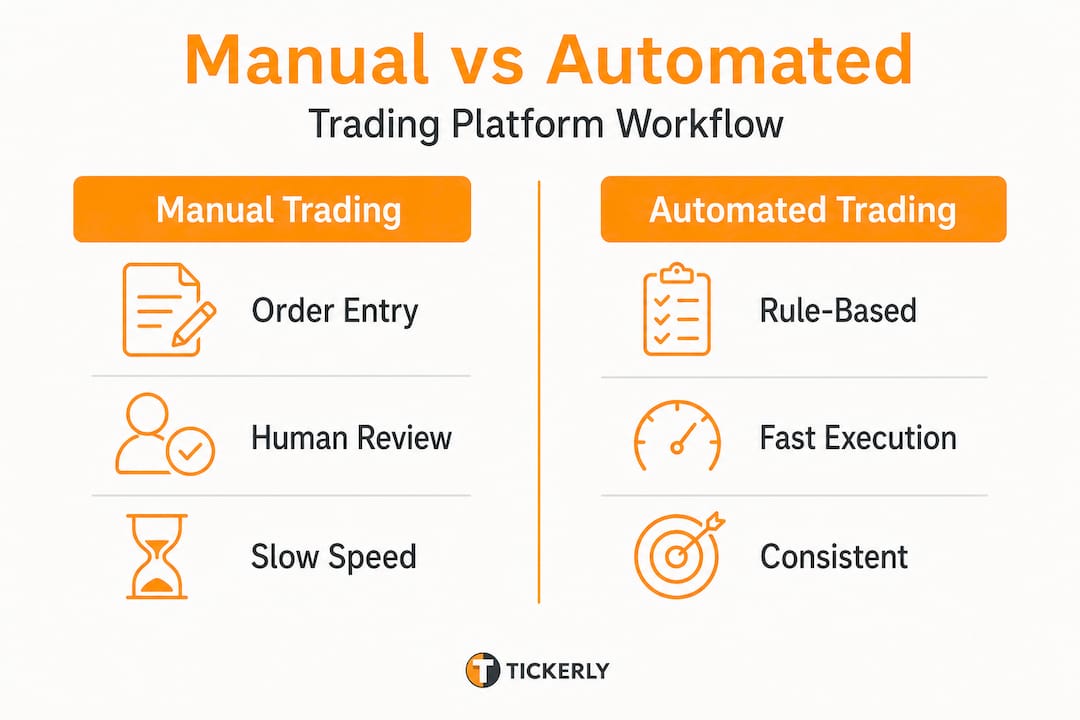
The contrast is stark. Manual trading introduces emotional variables at every decision point. You might hesitate to exit a losing position or enter too aggressively after a winning streak. Automated trading eliminates that variability by executing predefined rules without hesitation or emotional interference.
Here’s a practical workflow comparison to illustrate the difference:
Manual trading workflow on a typical platform:
-
Log into your trading platform and review your watchlist.
-
Analyze current market conditions using built-in charts or TradingView.
-
Identify a potential trade setup based on your strategy rules.
-
Manually calculate position size, set stop-loss and take-profit levels.
-
Enter the order and monitor it actively.
-
Adjust or close the position based on evolving conditions.
Automated trading workflow via TradingView and platform API:
-
Write and backtest your Pine Script strategy in TradingView.
-
Configure webhook alerts to send signals to your automation layer.
-
The automation system receives the signal and formats an API order.
-
The platform executes the order at near-instantaneous speed.
-
Risk parameters trigger automatically if conditions are met.
-
Reporting tools log the trade for later analysis.
The automated workflow removes steps three through five from human control entirely. That’s where the real efficiency gains come from. Autotrading with TradingView at this level requires a platform that handles API calls reliably and processes webhook data without dropping signals.
It’s also worth noting that how TradingView automation works involves several layers: the strategy layer (Pine Script), the signal layer (webhook alerts), and the execution layer (the platform’s API). If any layer introduces friction or errors, your strategy performance suffers regardless of how good the underlying logic is. For traders moving toward algotrading on TradingView, selecting a platform that handles all three layers cleanly is a prerequisite, not an afterthought.
How trading platforms elevate automated strategies with TradingView
With that comparison in mind, let’s sharpen the focus: how do platforms specifically amplify the performance of your TradingView strategies?
The most direct answer is signal fidelity. When your Pine Script strategy generates a buy or sell alert, your platform determines how accurately and how quickly that instruction becomes a filled order. As Investopedia confirms, trading platforms give customers access to forex markets and allow research and order processing — and for automated traders, order processing quality is everything.
Here’s how the right platform specifically elevates your TradingView setup:
-
Signal-to-trade fidelity: Platforms with robust webhook support convert your TradingView alerts into API calls without data loss or delay. This means your strategy fires exactly as coded, every time.
-
Multi-asset and multi-account execution: Advanced platforms allow a single strategy to run simultaneously across multiple trading pairs, accounts, or exchanges. A BTC/USD strategy, for instance, can inform execution across different exchange automation options without duplicating your Pine Script code.
-
Real-time analytics feedback loop: Platforms that feed real-time execution data back into your analytics stack allow you to identify when live performance deviates from backtested expectations. Catching that drift early is critical for long-term profitability.
-
Reduced emotional bias: Because the platform executes without your moment-to-moment involvement, the psychological traps — fear, greed, overconfidence — are removed from the equation. This is one of the most underappreciated advantages of full automation.
-
Faster reaction to market events: Markets can move sharply in seconds. An automated platform reacts in milliseconds. That speed advantage is particularly valuable in crypto markets where volatility is extreme and opportunities close quickly.
-
Scalability without added workload: Running ten strategies manually would require ten simultaneous mental threads. Automated platforms scale indefinitely without adding to your cognitive load.
Pro Tip: Use your platform’s paper trading or sandbox mode to validate the entire automated pipeline — from TradingView alert to executed order — before going live. This catches webhook formatting errors, API authentication issues, and order sizing bugs before real capital is at risk.
Understanding data-driven trading strategies also reveals why data quality from your platform matters as much as strategy logic. If your platform provides lagged or inaccurate price data, your strategy will fire on stale signals, producing results that never match your backtests. High-quality data is the fuel; your strategy is the engine; the platform is the drivetrain that connects them.
Why most traders underestimate the power of the right platform
Here’s a perspective you rarely see in trading guides: most traders spend 80% of their optimization energy on strategy logic and almost none on platform selection. That’s a fundamental misallocation of effort.
We’ve seen traders with genuinely excellent Pine Script strategies underperform significantly because their platform introduced even 1 to 2 seconds of unnecessary latency. In automated trading, that latency gap compounds over hundreds of trades into a meaningful performance drag. The strategy wasn’t broken. The platform was the bottleneck.
There’s another dimension that rarely gets discussed: platform reliability under market stress. During high-volatility events — Federal Reserve announcements, surprise crypto exchange news, geopolitical events — trading platforms experience their highest load exactly when your strategy most needs precise execution. A platform that performs well in calm markets but degrades under stress will produce your worst slippage at your most critical moments.
Platform choice also directly shapes your security in trading automation. API key management, IP whitelisting, and encrypted data transmission are platform-level protections. If your platform’s security architecture is weak, your automation setup becomes a vulnerability regardless of how carefully you’ve coded your strategy.
Our genuine recommendation: treat platform selection with the same rigor you apply to strategy development. Evaluate latency benchmarks, documentation quality, uptime track records, and community feedback from other automated traders. The right platform doesn’t just execute your strategy — it amplifies it.
Take your TradingView automated strategies further with Tickerly
If you’ve made it this far, you understand that platform choice is not a footnote in your automation journey — it’s central to your results. Tickerly is built specifically to bridge TradingView strategies and live market execution, turning your Pine Script signals into fully automated trades without the complexity of building custom API integrations from scratch.
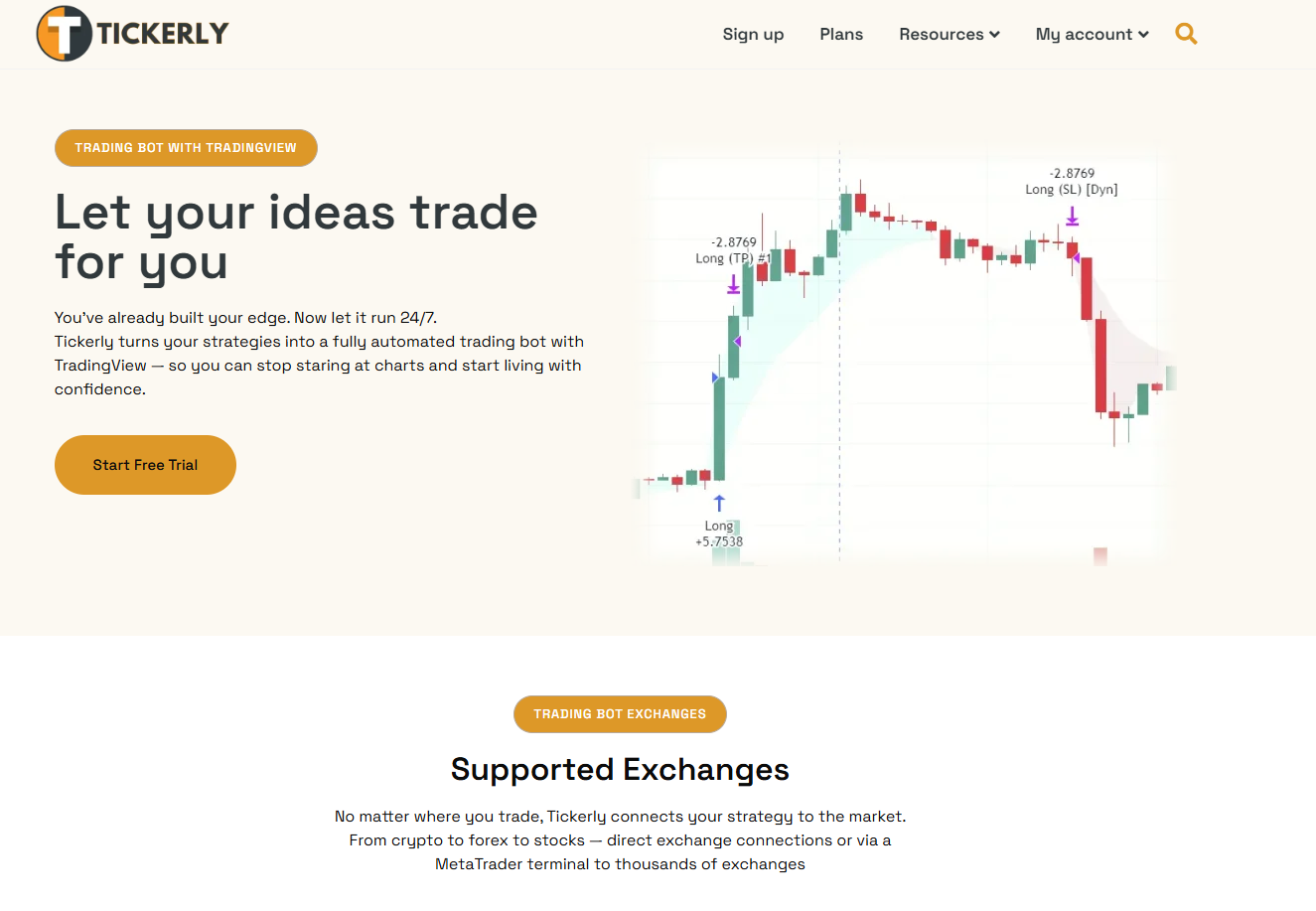
Whether you’re just exploring the TradingView strategies guide or already running live bots, Tickerly provides the tools, documentation, and platform connectivity to support every stage of your automation journey. Discover the full range of automated bot benefits and learn proven methods for optimizing trading strategy performance over the long term. Tickerly makes the technical layer manageable so you can stay focused on what matters most: building strategies that win.
Frequently asked questions
What defines a modern trading platform?
A modern trading platform is broker-supplied software enabling traders to access markets, analyze prices, and execute orders securely, typically with API access and real-time data integration for automated workflows.
How does automation differ from manual trading on platforms?
Automation uses coded rules to execute trades with millisecond speed and consistency, while manual trading involves personal decision-making that introduces latency and emotional variables. Trading platforms act as portals for both approaches but deliver dramatically different results depending on execution method.
Can TradingView strategies be automated with any platform?
Not all platforms support TradingView automation; you must verify webhook compatibility, API availability, and integration depth before assuming your Pine Script strategy can run hands-free on a given broker or exchange.
What are the risks of automated trading platforms?
Key risks include technical failures such as API downtime, flawed strategy logic executing at scale, and insufficient oversight — making platform reliability, uptime guarantees, and built-in risk management tools essential selection criteria.
Why does platform choice impact trading performance?
Platform choice affects execution speed, automation compatibility, data feed quality, and system reliability — all of which directly influence how accurately your backtested strategy performs in live market conditions.