

Real time execution for TradingView alerts means minimizing the round trip from signal to filled order so your strategy’s edge survives the seconds it takes to act. The core rule: measure your end-to-end latency (p50 and p95, at minimum) before you spend a dollar on infrastructure, then fix whatever leg is actually slow. A tool like Tickerly can shorten that alert-to-fill path, but the fix only matters if you know where the delay lives.
TL;DR:
Most retail traders’ delays are caused by webhook processing, API overhead, and server location, not by network ping times.
Measuring p50 and p95 round-trip latency across all pipeline steps reveals the true bottleneck, not just ping tests.
Strategies with an alpha horizon under a second benefit most from optimized low-latency setups, such as colocated servers and WebSocket connections.
Switching from REST polling to persistent WebSocket or FIX connections can cut delay by up to 30 milliseconds per order.
Using a tool like Tickerly can help turn TradingView alerts into live orders with minimized delay, but only after measuring your current latency profile.
Table of Contents
-
What Does Real Time Execution Actually Mean for Your Alerts?
-
How Do You Reduce Avoidable Latency in Your Execution Pipeline?
-
What Regulatory Factors Affect Automated Real Time Execution?
-
Turn TradingView Alerts Into Live Orders Without the Guesswork
What Does Real Time Execution Actually Mean for Your Alerts?
Real time execution is not a single event. It is a chain of handoffs, and each one adds delay before your order reaches the exchange.
-
Alert dispatch (TradingView): your Pine Script condition fires, and TradingView sends a webhook. This step alone can carry variable delay depending on server load and your alert configuration.
-
Webhook delivery and processing: a cloud copier or automation layer receives the payload, parses it, and translates it into an order instruction. A poorly built copier, especially one running single-threaded webhook processing or symbol mapping middleware in the wrong region, can introduce queuing delays that have nothing to do with network physics.
-
Broker or exchange matching: the order hits the venue’s matching engine, competes with other order flow, and gets acknowledged or filled.
-
Order type resolution: a market order resolves the price uncertainty into fill certainty; a limit order does the opposite, holding your price but risking no fill at all.
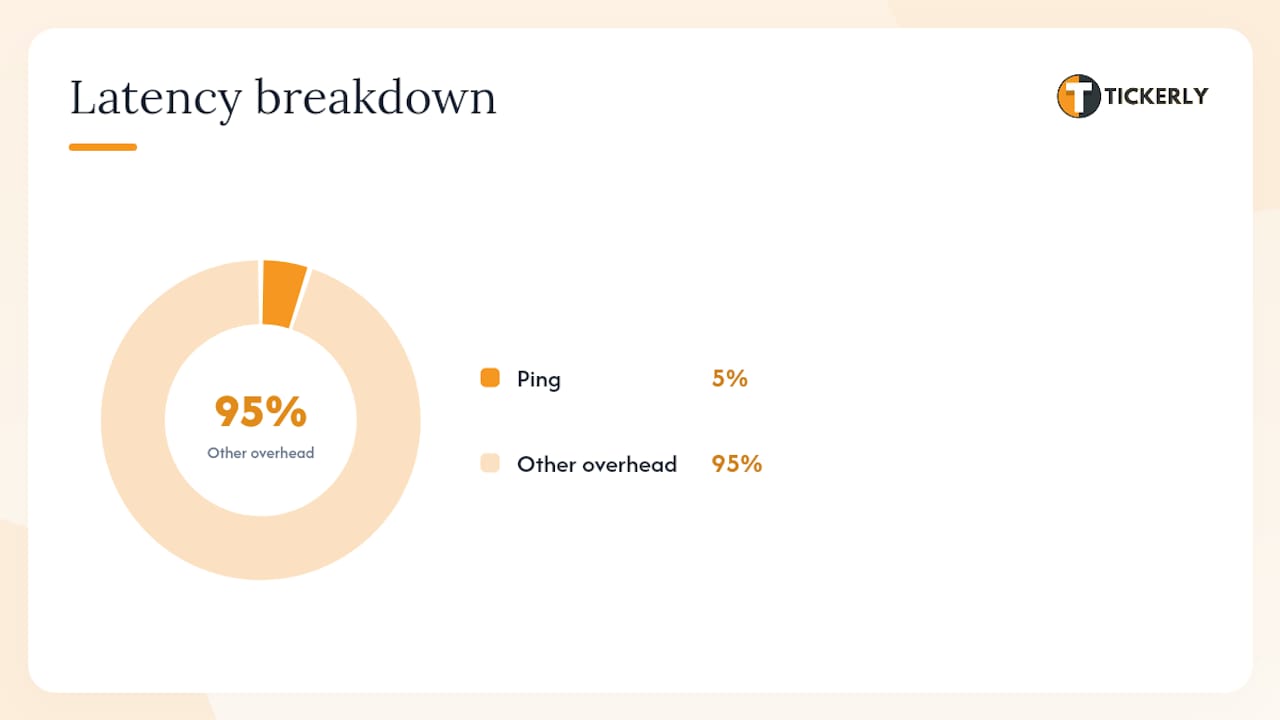
Ping tests miss most of this. Round trip network latency can account for as little as 5% of total execution time, with API overhead, queuing, and matching engine processing making up the rest. That is why traders who obsess over ping numbers but never look at their webhook copier’s processing time are optimizing the wrong leg.
Which Trading Styles Actually Need Sub-Second Execution?
Not every strategy needs to shave milliseconds. The right question is whether your alpha decays faster than your current latency.
-
Scalpers and news traders: a few hundred milliseconds of delay can turn a profitable entry into a losing one, especially around high-volatility events.
-
Copy traders and signal followers: delay compounds across the copier layer plus the exchange, so even a well-optimized personal setup can lag if the source signal itself is slow.
-
Intraday swing traders: seconds of delay rarely break the trade, but consistent slippage still erodes edge over hundreds of trades.
-
Position and swing traders: execution speed barely matters here. A limit order filled two seconds later changes nothing material.
The decision rule is simple: compare your strategy’s alpha horizon (how long the opportunity actually lasts) against your measured median latency. If your edge lasts 30 seconds and your round trip is 300 milliseconds, speed is not your bottleneck. If your edge lasts 2 seconds, it is.
How Do You Reduce Avoidable Latency in Your Execution Pipeline?
Most retail setups lose time in predictable places, and the fixes come in a rough order of impact.
-
Switch from REST polling to persistent WebSocket or FIX connections. Creating a new HTTP session for every order adds roughly 10 to 30 milliseconds of handshake overhead per order; a persistent connection eliminates that penalty entirely and cuts variance.
-
Host your execution layer close to the exchange. REST round trips commonly run 50 to 500 milliseconds, while WebSocket streams typically run 5 to 50 milliseconds, and a co-located VPS near the exchange can push network latency down to 1 to 5 milliseconds.
-
Keep the hot path minimal. Separate signal computation from order execution. Store computed signals in shared memory so the execution loop acts synchronously without waiting on I/O, and avoid blocking calls anywhere near the order-submission code.
-
Build idempotency and a retry taxonomy into every order request. Use unique client order IDs and classify errors so your system only retries requests that are actually safe to retry rather than duplicating fills.
-
Use WebSocket order-submission endpoints where the exchange offers them, not just market data streams. The milliseconds saved on the order path matter more than the milliseconds saved on the data feed.
Pro Tip: Before touching your architecture, log timestamps at every leg for a single day of trading. You will almost always find one obvious bottleneck, usually the webhook copier or a REST call you forgot was still there, that accounts for most of your delay.
How Do You Measure Your Real Execution Quality?
You cannot optimize what you have not measured, and a demo account will lie to you about it.
Capture four timestamps for every order: when the signal generated, when it was sent, when it was acknowledged, and when it filled. From those, compute round trip time for each trade, not just one lucky (or unlucky) example.
-
Gather at least a few dozen trades before trusting your numbers. A single fast fill tells you nothing about your system’s actual behavior.
-
Report median (p50) and tail percentiles (p95, p99), not averages. Tail latency drives real losses more than the average ever will, especially during volatile sessions when slow fills hurt most.
-
Track fill ratio, rejection rate, cancel ratio, and slippage against a clear benchmark price, not just execution speed alone.
-
Pull timestamps from your platform’s own journal (MetaTrader’s Journal is a common example) or your exchange API logs. A demo account will typically understate real slippage and queuing behavior compared to live liquidity.
A quick statistic worth internalizing: on many retail setups, the ping component of total latency is closer to 5% of the picture than the whole story, which means the other 95% (API overhead, queuing, matching) is where your optimization budget should actually go. Tools like Tickerly’s round trip measurement guide walk through building this kind of histogram before committing to any infrastructure spend.
Market vs. Limit: Which Order Type Fits Your Strategy?
The order type you choose reroutes risk. It does not eliminate it.
-
Market execution guarantees a fill and prioritizes speed, but it can produce slippage, especially during high-volatility events when the book moves between signal and submission. Scalpers and news traders typically accept this tradeoff because a delayed fill is worse than a slightly worse price.
-
Limit or instant execution gives you price certainty but risks a non-fill or requote if the market runs away from your level. This fits swing and position traders who care more about entering at the right price than entering this exact second.
-
Whichever you choose, calculate total cost as spread plus commission plus slippage, not spread alone. A tighter spread with worse slippage can cost more than a wider spread with reliable execution.
What Should Your Pre-Launch Execution Checklist Look Like?
Before you run real capital through an automated pipeline, run through a short, unglamorous checklist.
-
Build your latency histogram across at least a few dozen trades, and set p50/p95 thresholds appropriate to your style. A scalper’s tolerance looks nothing like a swing trader’s.
-
Verify idempotent order IDs, retry rules, and reconnect behavior. Force a disconnect during testing and confirm your system reconciles state correctly instead of duplicating or dropping orders.
-
Add pre-trade risk checks in memory: max notional per trade, max concurrent trades, and spread caps that block execution when conditions are abnormal.
-
Wire up monitoring alerts for rejection spikes, unusual cancel ratios, or latency drift so you catch degradation before it costs you a session’s worth of trades.
Pro Tip: Run this checklist against a small live position size first, not a demo account. The queuing and slippage behavior under real liquidity almost never matches what a simulated environment shows you.
What Regulatory Factors Affect Automated Real Time Execution?
Automating execution does not remove your compliance obligations. It just moves the point where they apply.
Brokers and exchanges generally require that automated order flow, however fast, still respects the venue’s own order-handling rules: rate limits, message throttling, and in some markets, restrictions on how orders can be canceled and resubmitted in rapid succession. Violating exchange-imposed rate limits is one of the most common (and avoidable) causes of rejected orders in retail bot setups, and it has nothing to do with your latency numbers.
Jurisdiction matters, too. Rules around algorithmic trading, market manipulation (such as prohibitions on quote stuffing or spoofing patterns that fast execution can accidentally resemble if a strategy misfires), and recordkeeping vary by country and by asset class. Prop firms and regulated brokers frequently impose their own execution and risk rules on top of exchange requirements, including position limits and mandatory stop-loss placement, that an automated system must respect even when it is technically capable of ignoring them.
None of this is a reason to avoid automation. It is a reason to keep your system auditable: log every order request, every rejection reason, and every retry so you can reconstruct exactly what happened if a regulator, broker, or prop firm ever asks. A system built with the idempotency and observability practices described earlier already produces most of this trail as a byproduct. Treat that logging as part of your execution stack, not an afterthought bolted on after a compliance question arises.
How Do Real Time Execution Technologies Compare?
The technology choices for automated execution fall into a few broad categories, and the right one depends on your trading style more than any single feature list.
Entry-level webhook copiers connect TradingView alerts to a broker or exchange through a simple relay service. These are easy to set up and work well for swing and position strategies where a second or two of delay changes nothing. Their weakness shows up under load or during volatile sessions, when single-threaded processing or poorly chosen server regions introduce exactly the kind of avoidable queuing delay described earlier.
Mid-tier automation platforms add persistent connections, multi-strategy handling, and proper exchange API integration instead of generic webhook relays. This is the category where most active day traders and Pine Script developers should be shopping, since it balances setup simplicity against real execution performance.
Enterprise and institutional execution stacks split the pipeline into market data ingestion, a signal engine, a risk engine, and a dedicated execution gateway, each tuned and measured independently so the dominant latency contributor gets the engineering attention. This level of infrastructure investment makes sense for high-frequency and institutional desks, not for a retail trader running a handful of Pine Script strategies.
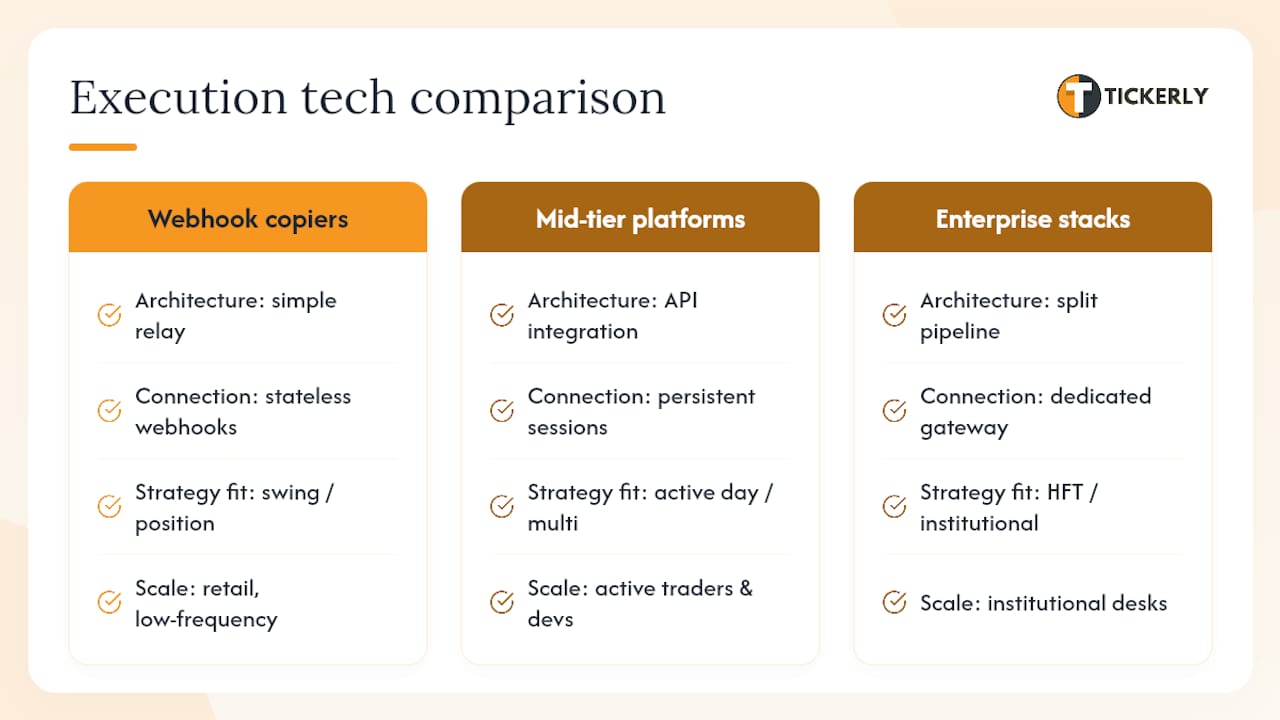
For most TradingView users, the practical decision is not REST versus FIX protocol or DPDK kernel bypass. It is whether your automation layer uses persistent sessions, supports the exchanges you actually trade on, and gives you visibility into where your latency comes from.
What Do Real Execution Failures Look Like in Practice?
Consider a swing trader running a Pine Script breakout strategy on a webhook copier hosted on a general-purpose cloud server in the wrong region. Their strategy fired correctly, but fills consistently landed several hundred milliseconds to over a second after the alert, and the trader assumed the exchange was slow. The actual cause was a single-threaded copier competing with other queued requests during volatile sessions, a well-documented failure mode in retail automation architecture.
Contrast that with a scalper who moved from a REST-polling bot to a WebSocket-based execution layer. REST round trips had been running in the 50 to 500 millisecond range with meaningful variance between orders. After switching to persistent streaming and hosting closer to the exchange, latency dropped into the 5 to 50 millisecond range on the data side, with network latency near the exchange server itself falling to single-digit milliseconds. The strategy’s win rate did not change. Its slippage per trade did, because fills landed closer to the intended price instead of chasing a market that had already moved.
The common thread in both cases: neither trader diagnosed the actual problem by feel. They found it by logging timestamps at each leg of the pipeline and comparing p50 and p95 latency before and after a change, exactly the discipline described earlier in this guide. Guessing at the bottleneck almost always points to the wrong fix.
Why Measurement Beats Marketing Claims Every Time
Most infrastructure spending in retail trading gets justified by feel, not data. A trader reads that WebSocket connections are faster than REST, assumes their setup must be the bottleneck, and buys a VPS in a region that does nothing for their actual latency profile. Measure first. Build the histogram, find the p95 tail, and only then decide whether the fix is a faster connection type, a better-hosted copier, or simply a different order type for your style.
The uncomfortable truth is that most retail traders do not have a speed problem. They have a measurement gap. A scalper losing edge to slippage and a swing trader losing nothing to latency can both be running the exact same infrastructure. The difference is whether their strategy’s alpha horizon actually requires the speed they are paying for. Tickerly’s own execution documentation leans on this same principle: connect the strategy, measure the round trip, and only then optimize, rather than assuming faster is automatically better for every account.
— Jay
Turn TradingView Alerts Into Live Orders Without the Guesswork
This platform closes the exact gap this guide walks through: the space between your Pine Script alert firing and an order actually landing on the exchange. It maintains persistent exchange connections, handles multiple strategies and alert streams simultaneously, and routes TradingView signals into supported crypto, forex, stock, and futures venues without custom execution code.
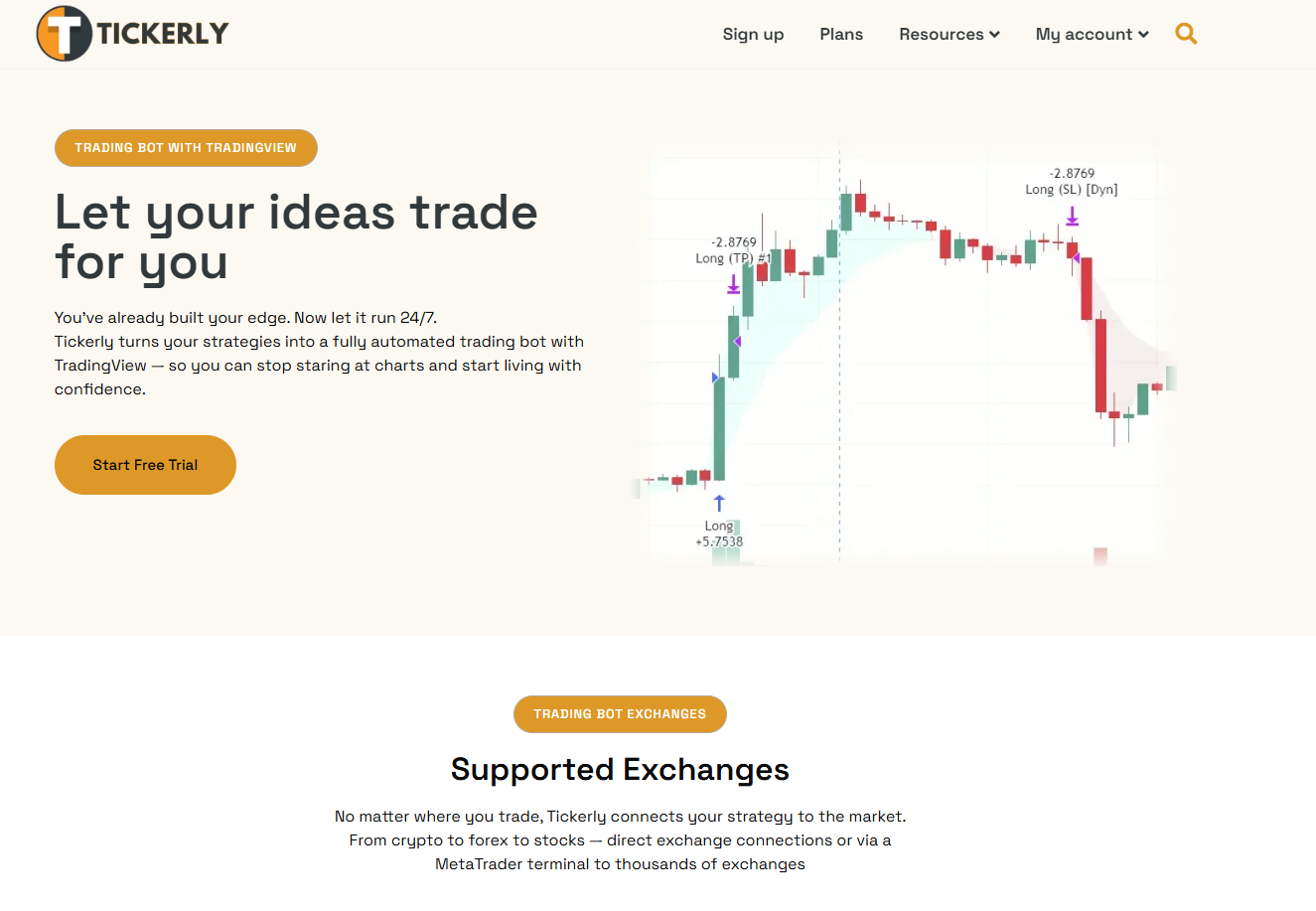
If you have already run the measurement checklist from this guide and found your webhook copier or manual entry process is the bottleneck, the practical next step is to see the pipeline in action. Tickerly’s TradingView strategy automation walkthrough shows exactly how an alert becomes a live order, and the step-by-step setup guide gets you from a Pine Script strategy to a running bot. Start with a small live position size, log your own p50 and p95 numbers, and compare them against your current setup before committing more capital.
Sources
FAQ
What Is Real Time Execution in Trading?
Real time execution is the process of turning a trading signal into a filled order with minimal delay across the entire alert-to-fill chain. For TradingView users, that chain runs from Pine Script alert dispatch through webhook processing to exchange matching, and the goal is measuring and minimizing the slowest leg.
How Fast Does Execution Need to Be for Day Trading?
It depends on your strategy’s alpha horizon. Scalpers and news traders typically need sub-second, often sub-500-millisecond, execution, while swing and position traders can tolerate several seconds of delay without any measurable impact on results.
What Causes Slow Execution on Automated TradingView Bots?
The most common causes are REST-based polling instead of persistent WebSocket connections, poorly hosted webhook copiers running single-threaded processing, and servers located far from the exchange’s matching engine. Round trip network latency alone often accounts for a small fraction of total delay, so the bottleneck is usually in processing, not ping.
Does Tickerly Reduce Execution Latency for TradingView Alerts?
Tickerly uses persistent exchange connections and dedicated infrastructure to convert TradingView alerts into live orders, avoiding the per-order overhead that REST-based or manually operated setups typically carry. Traders should still measure their own p50/p95 latency after setup to confirm results for their specific exchange and strategy.
Should I Use Market or Limit Orders for Faster Execution?
Market orders guarantee a fill and suit strategies where timing matters more than price, while limit orders guarantee price but risk not filling at all. The right choice depends on whether your strategy’s edge depends more on speed or on entering at a specific level.
Recommended
-
Demystifying TradingView scripts: boost your automated trading
-
TradingView Low Latency Bots: Measure Round Trip Latency Before You Buy
This article was produced with Al assistance and reviewed for accuracy. It is provided for general information only and is not professional or financial advice.