

Tickerly is the strongest overall pick for automating a TradingView strategy into live execution, thanks to fast alert routing from dedicated servers near major exchanges and multi-strategy support. If you run a fixed EA-style approach instead, Forex Gold Investor stands out for gold specialists, FXStabilizer PRO for traders who prioritize drawdown control, and Forex Fury for scalpers who want configurable presets. Verify every one of these against a live, third-party tracked account before funding anything.
TL;DR:
Most tested systems with short histories, like three weeks of screenshots, are less reliable than those with multiple years of verified, third-party tracked performance.
Tickerly excels at executing fully customized TradingView strategies with minimal lag, supporting multiple assets simultaneously and requiring no code beyond alert setup.
Specialist EAs like Forex Gold Investor and FXStabilizer PRO are best used for fixed strategies focused on gold or conservative risk, but require careful verification of drawdowns and market conditions.
Proper testing involves staged verification, including backtesting, forward testing, demo, and small live accounts, with continuous monitoring afterward.
Avoid over-leveraging and trust only long-term, independently verified accounts, since one sharp drawdown or unverified data can wipe out unprepared traders.
Table of Contents
Best Forex Trading Bots: How the Top Picks Compare
Picking the best forex trading bots starts with matching strategy type to your actual trading style, not chasing the highest advertised win rate. The table below lines up the top contenders across the criteria that matter most: what each is built for, how it trades, where it runs, and how much proof backs its claims.
Tickerly leads the list because it solves a different problem than a packaged EA does. Rather than locking you into one hard-coded strategy, it turns whatever you’ve already built in Pine Script into a live, executing bot, which matters if you trade multiple setups or asset classes at once. The EAs that follow are narrower by design, and that narrowness is often the point: a gold specialist EA doesn’t need to know how to trade EURUSD.
Treat every “verified track record” column as a starting point, not a conclusion. A bot with two years of Myfxbook history and a bot with three weeks of screenshots are not comparable, even if their marketing pages look identical.
Detailed Reviews of Each Shortlisted Forex Bot
Every entry below deserves a closer look before you attach it to a funded account. Some have years of public history behind them; others are thinner on documentation, and that thinness itself is information.
Tickerly isn’t a fixed strategy, it’s the execution layer underneath whatever strategy you already trust. If you’ve built and backtested a system on TradingView, Tickerly connects that alert stream to your broker or exchange account with minimal lag, and on the forex plans (Level 3 and up) it runs unlimited strategies at once, with 1,000 alerts a day (2,500 on Level 4 Ultra), so you can run a scalping setup on one pair and a swing system on another without juggling two separate platforms. Setup requires no code beyond your existing Pine Script alerts. The verification checkpoint here is different from an EA: you’re not checking a vendor’s equity curve, you’re checking your own strategy’s backtest and forward-test results, then confirming Tickerly’s execution matches your alert timestamps closely. The risks and rewards of forex bot automation are worth reading in full before you connect a live account.
Forex Gold Investor targets one instrument and one instrument only: XAUUSD. That narrowness is a strength if you already trade gold and want a specialist tool tuned to its volatility patterns, rather than a generalist EA retrofitted onto a metal that behaves nothing like EURUSD. Strategy type leans trend and breakout, matching gold’s tendency to run hard once it moves. Platform compatibility is standard MT4/MT5. Before funding, pull up the vendor’s live tracker and check the drawdown during gold’s sharper volatility spikes, not just the smooth uptrending stretches. A red flag here is any marketing page that shows only cumulative profit charts without a visible drawdown curve.
MultiPair EA spreads trades across several currency pairs at once, aiming to smooth the equity curve the way a diversified stock portfolio smooths single-stock risk. Strategy type is basket-style, trading correlated and uncorrelated pairs simultaneously. The verification checkpoint matters more here than with single-pair EAs: a multi-pair system can look stable while quietly concentrating risk if several pairs move together during a dollar-driven event. Ask the vendor directly which pairs are actively traded and whether correlation limits are built in.
Market Master is built for traders who hold positions longer than a scalper would, using trend-detection filters to enter and trailing logic to lock in gains as a move develops. It suits swing traders more than day traders. Check sample length carefully. A trend-following system can look brilliant during a strong directional year and mediocre during a choppy one, so a two-year track record spanning both regimes tells you far more than a six-month record from a trending period.
FXStabilizer PRO markets itself on what it doesn’t do: chase big wins. Its stated priority is drawdown containment and conservative position sizing, which makes it a reasonable fit if your main goal is capital preservation rather than maximizing returns. The trade-off is usually a lower headline return, and that trade-off is exactly what you want in a conservative tool. Verification here should focus almost entirely on the max drawdown figure and how consistent it’s stayed across different market conditions, since that consistency is the entire value proposition.
Forex Fury is one of the more established names in the retail scalping space, with configurable risk modes that let you dial aggression up or down. Strategy type is high-frequency scalping, which means execution speed and spread sensitivity matter enormously. It has one of the longer public track records among packaged EAs, which is worth something on its own.
-
What to check: which risk mode generated the published results, since “aggressive” and “conservative” presets can post very different drawdown numbers.
-
Setup needs: a broker with tight spreads and low latency; scalping strategies degrade fast on slow execution.
-
Red flag to watch: any review citing only the best-performing risk mode without disclosing the others.
Forex Diamond bundles three distinct trading modules, trend, countertrend, and scalping, into a single package you can tune to current conditions. That flexibility is appealing but adds a verification burden: a blended equity curve can mask the fact that one module is doing most of the losing while another covers for it. Ask specifically which module was active during any drawdown period shown in marketing material.
GPS Forex Robot relies on systematic entry logic paired with what the vendor describes as recovery mechanics. That phrase deserves scrutiny. “Recovery mechanics” is sometimes a euphemism for martingale-style position sizing, where the bot increases trade size after a loss to recover faster. That approach can produce impressive-looking win rates right up until a losing streak that a rigid drawdown limit can’t absorb.
WallStreet Forex Robot has been through multiple versions over a long commercial run, which gives it more historical scrutiny than newer entrants simply because more traders have had time to test it. Longevity isn’t proof of safety, but a bot that’s survived several market cycles under public review has at least been stress-tested by circumstance. Check which version any published results refer to, since strategy logic often changes meaningfully between releases.
Robotron specializes in high-frequency scalping during low-liquidity night sessions, when spreads on major pairs often tighten. That’s a legitimate edge on paper, but it depends entirely on your broker offering genuinely low spreads during those hours. Test on a demo account with your actual broker’s overnight spread conditions before trusting any published backtest, since spread assumptions in a vendor’s own testing environment may not match yours.
Waka Waka is positioned around news and event-driven price action, reacting to volatility spikes around scheduled releases. News strategies carry a specific risk: slippage during high-impact events can be severe, and a backtest run on historical data often can’t fully capture the execution conditions of a live news spike. Verify performance specifically during past high-impact events, not just averaged across all trades.
Infinity Trader combines scalping and trend logic into one hybrid system marketed as adaptable across market conditions. Hybrid systems are harder to audit than single-strategy bots because you can’t always tell which logic triggered a given trade. Request a trade-by-trade log if the vendor offers one, and confirm the hybrid approach doesn’t fall back on grid-style averaging when a trend trade moves against it.
For the remaining entrants in circulation, including Happy Gold, JapanStrike, FX Proctor, and roundup aggregators like the Top 10 Robots App, the same rule applies without exception: locate a live, third-party tracked account before you read a single marketing claim. Aggregator apps in particular tend to compile vendor-submitted data without independently verifying it, so treat their rankings as a starting point for research, never as a substitute for it.
How to Choose and Test a Forex Trading Bot
Picking the right automated system is a four-step process, and skipping any step is how traders end up funding something they never actually understood.
-
Define your goals, capital, and drawdown tolerance first. A scalper with a $2,000 account and a swing trader with a $50,000 account should never be evaluating the same bot the same way. Decide your maximum acceptable drawdown in dollars, not just percent, before you look at a single product.
-
Verify live, third-party tracked performance. Reviewers consistently point to Myfxbook and FX Blue as the reliable way to check a bot’s real record, since vendor screenshots can be cropped, cherry-picked, or entirely fabricated. Look at the equity curve shape, trade count, trade frequency, and profit factor together, not any single number in isolation.
-
Run the full test sequence: backtest, forward test, demo, then small live scale. A staged testing workflow catches problems that a backtest alone never reveals, particularly slippage and execution differences between a demo environment and a live broker feed.
-
Monitor continuously once live. Set alerts for drawdown thresholds, review trade logs weekly, and keep a written record of which software version you’re running so you can trace performance changes back to updates.
One number worth remembering: an 80%+ advertised win rate is one of the clearest warning signs of hidden martingale or curve-fitted logic, since that kind of consistency usually comes from a system that recovers small losses often and occasionally takes one catastrophic hit.
Before funding anything, ask the vendor directly: How long has the live account been tracked? Is the tracker independently hosted or vendor-controlled? What’s the maximum historical drawdown, and did it happen in a Myfxbook-verified account or only in a backtest?
How to Read a Verified Track Record the Right Way
A Myfxbook or FX Blue page is only useful if you know which numbers actually matter. The equity curve tells you the shape of the ride, smooth and steady versus jagged with occasional cliffs, and that shape often matters more than the total return. Trade count and trade frequency tell you whether you’re looking at a statistically meaningful sample or a lucky few weeks. Drawdown and profit factor together tell you what kind of pain you’d have tolerated to get that return.
-
Equity curve: look for gradual, consistent growth rather than a flat line punctuated by sharp spikes.
-
Trade count: fewer than 100 trades makes any win rate close to meaningless statistically.
-
Drawdown: compare peak-to-trough loss against the account’s total growth, not just the headline percentage.
-
Profit factor: a ratio above 1.5 sustained over a long sample is far more meaningful than a short burst above 3.0.
-
Trade length: extremely short average holding times paired with a high win rate often points to scalping strategies vulnerable to slippage.
One insight experts return to again and again: a single metric never tells the full story. A high win rate paired with an unremarkable profit factor often signals a system taking small, frequent wins while occasionally absorbing a large loss, the classic signature of hidden martingale logic. Curve-fitting compounds the problem, since a strategy over-optimized to historical data can look flawless in a backtest and fall apart within weeks of live trading.
Vendor backtests and screenshots are not sufficient evidence on their own. Independent, third-party tracked accounts with long sample sizes are what separate a genuinely tested system from a marketing pitch.
Aim for a minimum of six months of live-tracked data, ideally spanning at least one period of unusual volatility, before treating any bot’s numbers as trustworthy.
Regulatory Compliance and Safety Considerations
Forex trading regulation varies by country, and where you’re based determines which protections actually apply to you. A broker regulated by a recognized authority in your jurisdiction typically offers stronger recourse if something goes wrong than an offshore broker with minimal oversight, though the specific rules and protections differ from one regulator to the next. Automated trading bots themselves generally aren’t regulated products; the regulation sits with the broker executing your trades, not the software generating the signals.
That distinction matters when a vendor claims a bot is “regulated” or “approved.” No major regulator certifies EA performance or approves trading algorithms as safe investments. What you should check instead is whether your broker is properly licensed in your jurisdiction and whether that broker’s terms permit automated trading tools at all, since some brokers restrict or ban EAs outright in their user agreements.
Before connecting any bot to a live account, confirm your broker explicitly allows algorithmic trading, check whether your account type has any restrictions on automated tools, and read the bot vendor’s terms for any liability disclaimers that shift risk entirely onto you. Running an unregulated or restricted tool on a broker that prohibits it can void your account protections entirely, leaving you with no recourse if a dispute arises.
Evaluating Customer Support and Community Resources
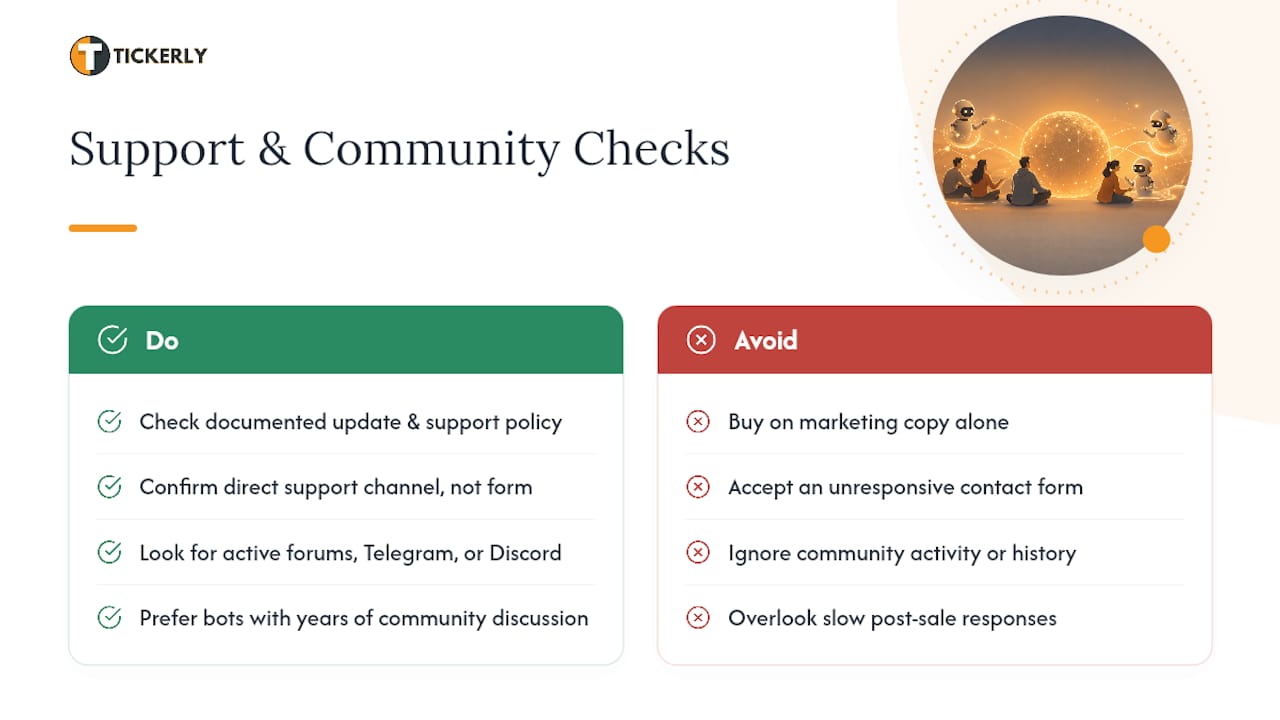
A bot’s support quality often matters more than its marketing copy once you’re actually running it live. Vendors with a documented update and support policy, covering patches for broker changes, platform updates, and compatibility fixes, give you a practical trust signal that’s easy to overlook when you’re focused purely on performance numbers.
Before buying, check whether the vendor offers a direct support channel, not just a contact form that goes unanswered. Look for active community forums, Telegram groups, or Discord servers tied to the product, since an engaged user base tends to surface problems, like a broker compatibility issue or an update bug, faster than a vendor’s own release notes will. A bot with years of community discussion attached to it gives you a much clearer picture of real-world reliability than a brand-new release with no public track record of user complaints or fixes.
Tickerly’s support model centers on direct assistance for connecting TradingView alerts to execution, since the setup process involves broker or exchange API configuration that benefits from responsive help rather than a static knowledge base alone.
Watch for vendors who go quiet after the sale. A support inbox that takes weeks to respond, or a forum where user questions about broker updates sit unanswered for months, tells you how that vendor will treat you the day something actually breaks. Ask directly, before purchase, how updates are communicated and whether support is included or sold separately.
Security Best Practices for Protecting Your Trading Accounts
Connecting any automated bot to a live trading account means handing over some form of access, whether that’s an API key, a VPS login, or platform credentials, and each of those access points needs its own safeguard. Never share your broker account password directly with a bot vendor; legitimate automation tools use API keys or platform-level integrations that don’t require your login credentials.
When generating API keys for exchange or broker connections, restrict permissions to trading only and disable withdrawal access wherever the platform allows it. That single setting is the difference between a compromised key costing you a bad trade versus costing you your entire balance. Enable two-factor authentication on every account touching your trading setup, including your VPS provider and your broker portal, not just your email.
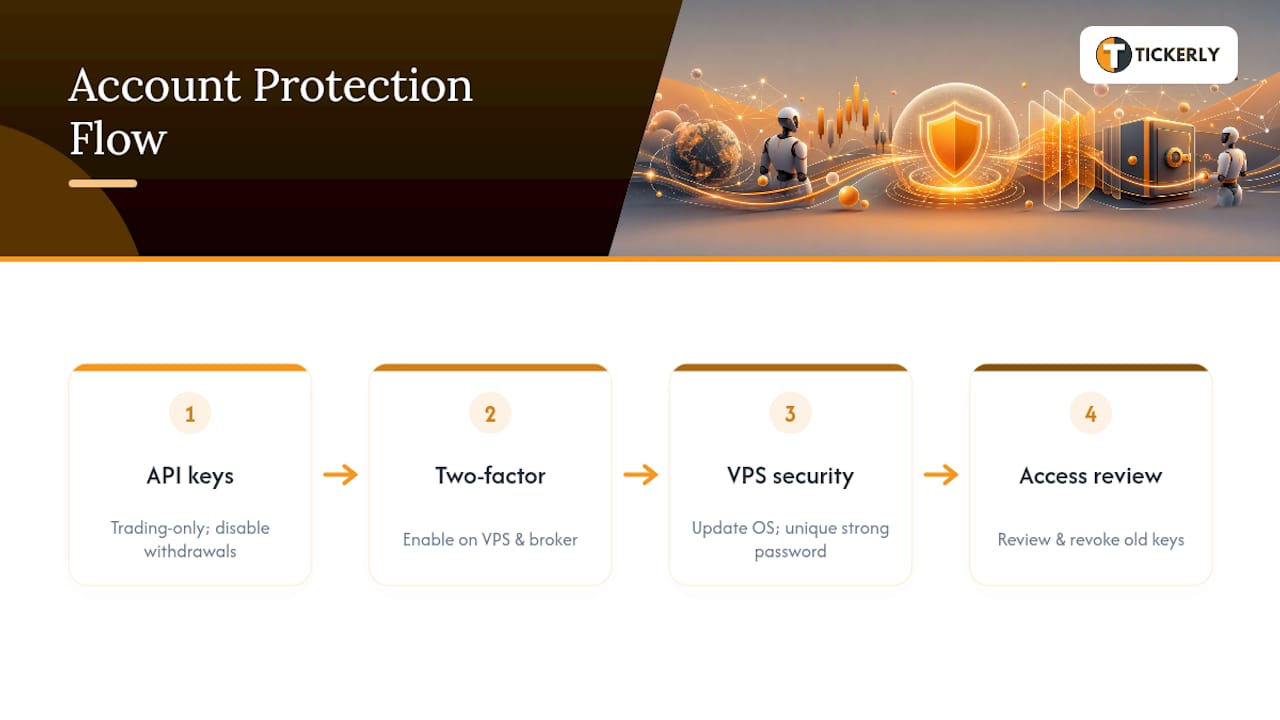
If you’re running an EA on a rented VPS, keep that VPS updated and use a unique, strong password rather than a default or reused one; VPS providers are a common weak point traders overlook. Review connected API keys and third-party permissions every few months, and revoke anything tied to a bot you’ve stopped using. Old, forgotten API access is one of the quieter risks in automated trading, sitting unused until it’s exploited.
Comparing Automation Features: Customizability and Alerting
Not every automated system gives you the same level of control once it’s running. Packaged EAs like Forex Fury or FXStabilizer PRO typically offer configuration through input parameters, adjustable lot sizing, risk percentage, session filters, but the underlying strategy logic itself stays fixed. You can tune how aggressively it trades; you generally can’t change what it’s trading on.
Tickerly works from the opposite direction: since it executes whatever strategy you’ve defined in Pine Script, the customization ceiling is set by your own coding, not by a vendor’s preset menu. That matters most for traders running multiple concurrent strategies across different assets, since a fixed EA generally can’t do that without running several separate licenses side by side.
Alerting is where the practical difference shows up daily. A packaged EA usually trades silently in the background with minimal notification beyond your platform’s own trade log. Alert-driven automation gives you a real-time record of exactly when a signal fired and when it executed, which becomes essential for auditing execution quality, particularly for scalping or news strategies where a few seconds of lag changes the outcome. Reviewing advanced alert configurations is worth doing before you commit to any automation approach, since alert granularity varies significantly between tools.
Algorithm Updates and Ongoing Maintenance
Every forex bot needs maintenance, and vendors who treat updates as an afterthought are telling you something about long-term reliability. Broker platforms change their execution rules, spread structures shift, and market regimes evolve, so a strategy tuned for 2023 conditions can quietly underperform by 2026 without a single line of its logic changing.
Packaged EAs typically receive periodic updates from the vendor, patches for new broker requirements, occasional logic tweaks, and compatibility fixes for new MT4/MT5 builds. Ask specifically how often updates ship and whether they’re included in your license or sold as a separate upgrade, since some vendors monetize updates aggressively after the initial sale.
For strategy-driven automation like Tickerly, maintenance responsibility shifts partly to you: since the platform executes your own Pine Script logic, you’re the one deciding when a strategy needs revisiting based on changing market behavior. That’s a trade-off. You lose the “vendor handles it” convenience of a packaged EA, but you gain full control over when and how your strategy evolves, rather than waiting on a vendor’s release schedule.
Either way, treat any bot as a maintained system, not a set-and-forget purchase. Reviewing performance monthly and checking for vendor updates before every major broker or platform change is standard practice among traders who’ve run automation for more than a year.
What We See Traders Get Wrong About Bot Automation
The most common mistake isn’t picking a bad bot. It’s over-leveraging a genuinely decent one, running position sizes far beyond what the bot’s own backtest assumed, and then blaming the software when a normal drawdown wipes out an account that was never sized correctly in the first place.
The second mistake is trusting screenshots over sourced data. A vendor’s cropped equity curve tells you nothing about the trades that didn’t make the marketing page. The third is skipping broker-specific testing entirely, assuming a strategy that performed well on one broker’s execution model will behave identically on another’s, when spread and slippage differences alone can turn a profitable system into a losing one.
Execution speed matters more than most traders assume, particularly for scalping and news-driven strategies where a few seconds of alert-to-order lag changes the outcome entirely. A strategy that backtests well on paper can bleed value in live conditions if the gap between signal and fill is too wide. That’s the core problem Tickerly was built to close, mapping TradingView alerts to execution with minimal delay so the strategy you tested is closer to the strategy you’re actually trading.
None of this replaces careful position sizing or genuine strategy validation. Automation removes emotional decision-making from execution. It doesn’t remove the responsibility to test, verify, and size positions correctly before you ever go live.— Jay
Tickerly: How It Works and When to Choose It
If you’ve built a strategy on TradingView and you’re tired of manually copying alerts into trades, Tickerly closes that gap directly, mapping your Pine Script alerts to live execution with minimal delay so you’re not losing edge to slow manual entry. Unlike a single packaged EA, from Level 3 it runs unlimited strategies simultaneously across forex, crypto, stocks, and crypto futures, which means you’re not stuck running separate tools for separate markets.
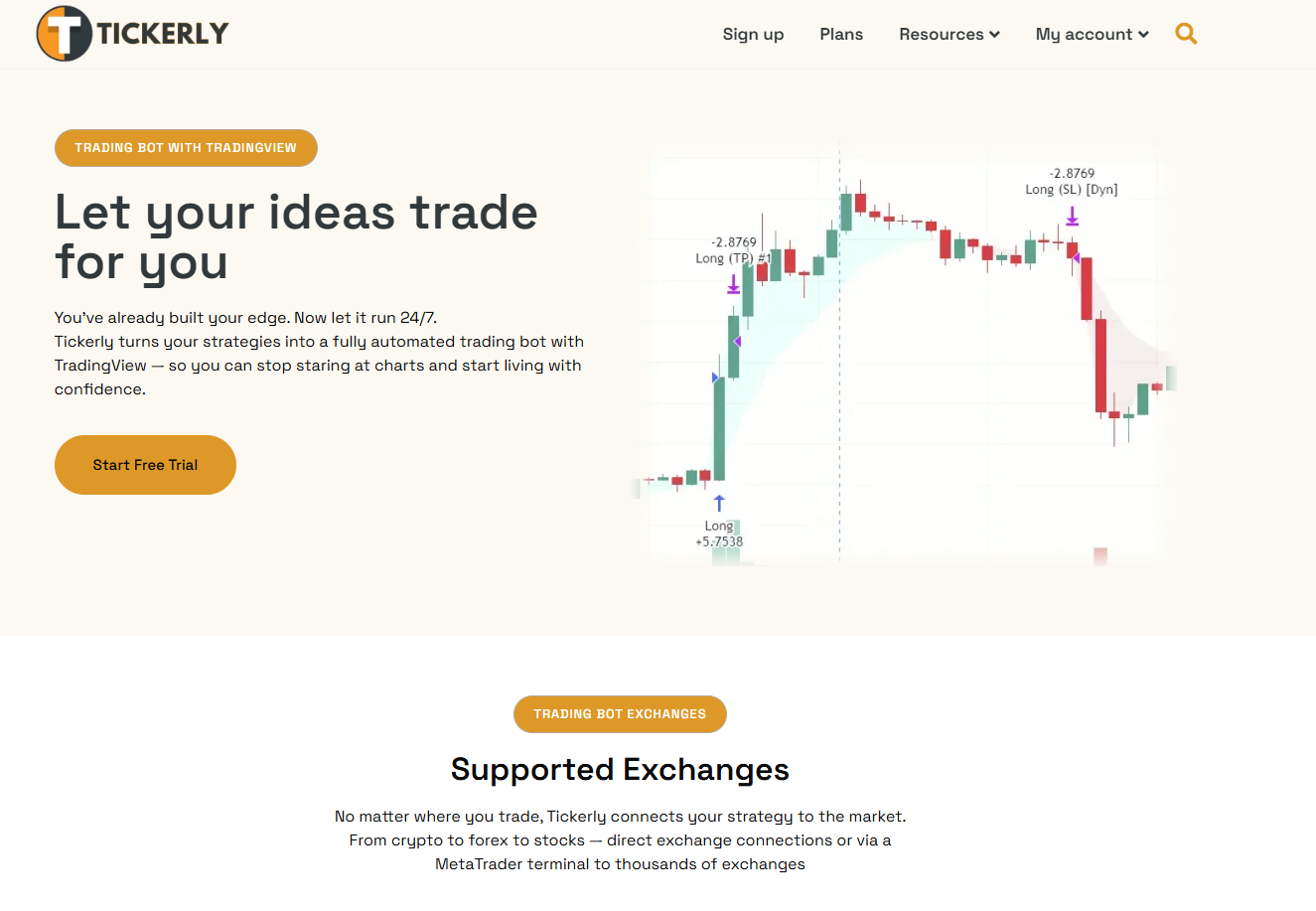
Setup connects directly to crypto exchanges and to Oanda, Capital.com and Alpaca through API keys, with no VPS needed for those direct connections. For MetaTrader 4/5, Tickerly sends your TradingView alerts to the Tickerly TV Connector EA running in your own terminal, so any MT4/MT5 broker or prop firm works; the terminal has to stay running, which is why a VPS is the usual setup. Either way, switching from manual to automated execution doesn’t mean abandoning the charting platform you already know. The 30-day free trial gives you room to test alert-to-execution reliability on your own strategies before committing to a paid tier, and pricing scales by asset class and strategy count rather than locking you into a one-size plan. Forex through Oanda and Capital.com starts at Level 3 ($29 a month), and MetaTrader 4/5 at Level 4 ($39 a month, up to 10 terminals).
A dedicated EA like Forex Gold Investor or FXStabilizer PRO still makes sense if you want a fixed, pre-built strategy with no coding involved and you’re comfortable trusting someone else’s logic entirely. But if you’ve already got a strategy you trust and just need it executed reliably and fast, Tickerly’s approach to automated forex trading is the more direct path. Start your trial today and see how your own strategy performs when execution speed stops being the bottleneck.
Primary Sources and Verification Links
Every performance claim in this guide should be checked against a live account, not taken on faith. Myfxbook and FX Blue remain the standard third-party platforms for verifying real trading history rather than vendor-supplied screenshots. The Forex Robot Nation testing methodology and the Forex Tester review of EAs and forex robots both informed the verification standards used throughout this roundup. For deeper background on execution mechanics and setup, Tickerly’s own guides on bot trading fundamentals and core automation concepts cover the technical details this article summarizes.
Sources
FAQ
Are forex bots profitable?
Some are, over long verified sample periods, but profitability depends entirely on strategy quality, risk controls, and execution conditions rather than the fact of automation itself. A bot with a solid, third-party tracked record over a year or more offers far more confidence than one with a few weeks of screenshots.
Is it possible to make $1,000 a day in forex?
It’s mathematically possible with a large enough account and aggressive position sizing, but it’s not a realistic baseline expectation for most traders, and any bot promising consistent returns at that scale should be treated with heavy skepticism. Sustainable automated trading targets steady, verifiable growth over time, not daily fixed-dollar targets.
Which is the most successful trading bot?
There’s no single universally “most successful” bot, since success depends on your strategy, risk tolerance, and asset focus. For TradingView users automating their own tested strategies, Tickerly is the strongest fit for execution reliability; for gold-specific trading, a specialist like Forex Gold Investor has a narrower but more tailored edge.
Do AI forex trading bots work?
Most retail products marketed as “AI” are actually static, hard-coded systems using grid or martingale logic rather than genuine adaptive machine learning that retrains on new data. Treat any “AI-powered” claim skeptically until the vendor can explain, specifically, what the model does differently from a rules-based EA.
Recommended
This article was produced with Al assistance and reviewed for accuracy. It is provided for general information only and is not professional or financial advice.