

Tickerly, Trade Ideas, StockHero, and TrendSpider stand out as the best day trading bots for active traders right now, each earning its place for a different reason. Tickerly leads for traders who already build strategies on TradingView and need low-latency, no-code execution across crypto, forex, and stocks. Trade Ideas wins on AI-driven equities scanning, StockHero simplifies bot creation through a marketplace model, and TrendSpider automates technical analysis for traders who want no-code strategy building. The comparison table, buying criteria, and verification checklist below explain exactly why.
TL;DR:
- Tickerly is ideal for traders with TradingView strategies, offering low-latency, no-code execution across multiple asset classes through direct exchange APIs.
- Trade Ideas provides AI-powered intraday scanning for U.S. stocks, suitable for traders seeking real-time trade ideas, not automation of their own strategies.
- StockHero simplifies bot creation with a marketplace model, ideal for beginners wanting to test pre-built strategies without coding knowledge.
- TrendSpider automates technical analysis and backtesting, catering to traders who rely on chart pattern recognition rather than price alerts.
- When choosing a bot, prioritize direct exchange integration, realistic backtests, proper API permissions, and avoid performance claims based only on screenshots or unverified data.
Table of Contents
- What Are the Best Day Trading Bots Right Now?
- How Do These Trading Bots Compare Side by Side?
- How Should You Choose the Right Day Trading Bot?
- How Do You Verify a Trading Bot’s Performance Claims?
- Where Does Tickerly Fit for Active Day Traders?
- What Automation Can and Can’t Do for a Day Trader
- Ready to Automate Your TradingView Strategy?
- Sources
- FAQ
What Are the Best Day Trading Bots Right Now?
Automated trading software has split into two camps: platforms that generate their own signals, and platforms that execute the signals you already trust. That distinction matters more than most reviews admit, because it determines whether a bot is replacing your strategy or amplifying it.
Here’s the shortlist, ranked by what each platform actually does best.
Tickerly converts TradingView strategy alerts into live, automated execution across crypto, forex, stocks, futures, and prop firm accounts. If you already build and refine strategies in Pine Script, or you’ve settled on a TradingView-based system that works, Tickerly removes the manual step between signal and order. It connects to exchange APIs directly, places orders within a fraction of a second from dedicated servers near major exchanges, and runs as many strategies as your plan allows (20 on Level 2, unlimited from Level 3), which means you can run a scalping system on one asset class and a swing system on another without juggling multiple platforms. No VPS for direct exchange connections, no custom coding. This is the pick for active day traders who’ve already validated a strategy and want it firing in real time without babysitting a chart all day.
Trade Ideas takes a different approach entirely. Instead of executing your strategy, it builds momentum-based trade ideas for you using an AI signal engine trained on intraday equities data. This is the tool for traders who want a machine constantly scanning thousands of U.S. stocks for volume spikes, breakouts, and unusual price action, then surfacing a ranked list of opportunities. It’s less “set it and forget it” and more “here’s what to watch right now.” Traders who like discretionary decision-making but want a research assistant working faster than they can scan a screener manually tend to get the most value here.
StockHero is built around accessibility. Its bot creation wizard walks you through building an automated strategy step by step, and its marketplace lets you rent or copy strategies other traders have already configured, similar in spirit to a strategy-sharing exchange. That marketplace model is the standout feature. If you don’t want to write logic from scratch and you’d rather test a strategy someone else has already put into production, StockHero shortens the learning curve considerably. It spans multiple asset classes, which makes it a reasonable entry point for traders who are still deciding which markets suit their style.
TrendSpider focuses on automated technical analysis. Its no-code strategy builder detects trendlines, support and resistance zones, and chart patterns automatically, then lets you backtest and deploy that logic without writing a script. The strategy tester is the real draw: you can run a technical setup against years of historical price data across both equities and forex before ever risking capital. For a trader who thinks in chart patterns rather than raw price alerts, TrendSpider automates the part of technical analysis that used to take hours of manual chart-scrubbing.
A few other names surface consistently across trading-bot roundups, including aggregator reviews that track platforms like Trade Ideas, TrendSpider, and StockHero alongside comparable tools. Coverage tends to cluster around the same handful of platforms because the category itself is narrow: real execution infrastructure, tied to real exchange APIs, is harder to build than a signal dashboard.
Here’s how to think about which one fits your trading style:
- If you already trade off TradingView charts and want your exact strategy automated, Tickerly is the direct fit.
- If you want AI-generated trade ideas for U.S. equities rather than automated execution of your own system, Trade Ideas serves that need.
- If you’re new to bot trading and want a guided setup with pre-built strategies to test, StockHero lowers the barrier to entry.
- If your edge is technical pattern recognition and you want that analysis automated, TrendSpider handles it without code.
None of these platforms are interchangeable. The mistake most traders make when shopping for day trading robot reviews is treating every “bot” as the same category of product. A signal generator and an execution engine solve different problems, and conflating them is how traders end up frustrated with a tool that was never built for their use case in the first place.
How Do These Trading Bots Compare Side by Side?
Execution speed claims vary because the platforms aren’t solving the same problem. A signal-generation tool and a direct-execution tool measure “speed” differently, which is exactly why the comparison below separates what each platform promises from what it’s actually built to do.
| Platform | Best For | Asset Classes | Execution Speed Claim | Backtesting / Paper Trading | Pricing Shape | Ease of Use | Exchange/Broker Integration |
|---|---|---|---|---|---|---|---|
| Tickerly | Active day traders needing TradingView automation and low-latency execution | Crypto, forex, stocks, futures, prop firm accounts | Places orders within a fraction of a second of the alert | Backtest in TradingView’s Strategy Tester, then run on the exchange’s demo account by naming the connection “test” | Monthly plans from $19, 30-day free trial | No-code setup, no VPS for direct exchange connections | Direct API connections to crypto exchanges, Oanda, Capital.com and Alpaca, plus MetaTrader 4/5 through a connector in your terminal |
| Trade Ideas | Day traders focused on U.S. equities and rapid opportunity scanning | U.S. equities | AI-driven scanning for fast idea generation, not direct order execution | Backtesting available for signal strategies | Subscription tiers | Moderate learning curve for full feature set | Broker integrations available for select partners |
| StockHero | Traders who want simple bot setup and a strategy marketplace | Crypto, stocks (varies by strategy) | Not positioned around raw execution speed; focus is ease of deployment | Paper trading supported through the bot wizard | Subscription tiers | Wizard-based setup, beginner-friendly | Exchange integrations vary by supported market |
| TrendSpider | Traders who prefer automated technical-analysis workflows and no-code strategy builders | Equities, forex | Not positioned as a low-latency execution tool; focus is analysis automation | Strategy tester with historical backtesting | Subscription tiers | No-code builder, moderate setup for advanced strategies | Broker integrations available for supported markets |
A quick reality check on execution speed: connection latency and the provider’s execution path, meaning whether it routes directly to a broker’s API or through a middleman, materially affects how fast a signal turns into a filled order. Any vendor unwilling to explain that path in plain language is worth a second look before you commit capital.
Three takeaways worth acting on:
Traders running a validated TradingView strategy who want it live without manual clicking should start with Tickerly, since it’s purpose-built for that exact workflow. Traders who don’t yet have a system and want the software to surface opportunities should lean toward Trade Ideas or TrendSpider, depending on whether they prefer momentum scans or chart-pattern automation. Traders new to bot trading entirely, who want to test pre-built logic before writing their own, get the gentlest on-ramp from StockHero’s marketplace, or can pick one of the thousands of published strategies in TradingView’s library and automate it with Tickerly without writing code.
How Should You Choose the Right Day Trading Bot?
Picking from the best trading algorithms on the market isn’t about finding the flashiest dashboard. It’s about matching the platform’s core function, execution, signal generation, or analysis automation, to what you actually need done. Here’s the criteria that actually separates a production-ready bot from a liability.
1. Execution quality over marketing claims. Ask exactly how the platform gets from alert to filled order. Does it connect directly to the exchange’s API, or does it route through an intermediary that adds latency? For active day trading, connection latency and execution path materially affect performance, and a vendor who can’t answer this clearly is telling you something.
2. Backtests that resemble reality. A backtest that ignores slippage, commissions, and partial fills is a fantasy, not a forecast. Ask whether the platform’s backtesting engine accounts for realistic order execution or just assumes every trade fills at the exact quoted price.
3. The API permission model. This is non-negotiable. The platform should only ever request read-only or trade-only API access, never withdrawal permissions. The SEC’s investor bulletin on automated trading makes read-only API access the baseline security practice for a reason: a bot with withdrawal rights turns a software bug or a compromised account into a drained wallet.
4. Real exchange and broker integrations. Confirm the platform actually supports the exchanges or brokers you trade on, not just a generic “we integrate with major exchanges” claim. Ask for the current list.
5. Pricing and strategy limits. Understand whether the plan caps the number of strategies, alerts, or trades per month, and whether hitting that cap mid-trading-day interrupts execution.
Before subscribing to any platform, ask the vendor these questions directly:
- Can you show a timestamped, third-party-verified track record, not a screenshot?
- What API permissions does the bot require, and can it be restricted to read-only or trade-only access?
- What security audits has the platform undergone, and when was the most recent one?
- What happens to open positions if the platform’s servers go down mid-trade?
- How does the backtesting engine model slippage and commission costs?
Watch for these red flags, because they show up constantly in day trading robot reviews that later turn into complaint threads:
- A vendor that requires withdrawal permissions on your exchange API key.
- Performance claims backed only by screenshots, never by an independent tracker or exportable trade log.
- Guaranteed returns or “risk-free” language. No legitimate platform promises this, and the CFTC has specifically warned that AI marketing claims for trading bots can be fraudulent.
- Pressure to upgrade to a higher tier before you’ve even paper-traded the strategy once.
- No clear answer about which exchanges or brokers the bot actually connects to.
Pro Tip: Before funding any live account, ask the vendor for their domain’s registration date and company background. The CFTC’s advisory on AI trading bots specifically flags newly registered domains and unverifiable company histories as common markers of fraudulent operations.
Here’s the rollout sequence that keeps risk proportional to confidence:
- Research the platform’s execution model and security practices before creating an account.
- Run a demo or sandbox environment if the platform offers one, to confirm the interface and setup match your workflow.
- Paper trade the exact strategy you intend to run live, for long enough to see it through multiple market conditions.
- Deploy with small live exposure first, sized so a full loss on that capital wouldn’t affect your broader trading plan.
- Scale gradually while monitoring execution logs, watching specifically for slippage between expected and actual fill prices.
The FINRA Day-Trading Risk Disclosure is blunt about this: day trading is extremely risky, can generate substantial commission costs, and disadvantages smaller accounts. Automation doesn’t change that math. It just changes who’s clicking the button.
How Do You Verify a Trading Bot’s Performance Claims?
Backtested returns almost always look better than live results, and the gap usually comes down to three failure modes that every trader evaluating automated trading software needs to understand before trusting a performance chart.
Overfitting happens when a strategy gets tuned so precisely to historical price data that it captures noise instead of a repeatable pattern. It looks brilliant on last year’s chart and falls apart the moment market conditions shift even slightly.
Slippage is the gap between the price a strategy expects and the price the order actually fills at, and it grows during volatile moves exactly when a day trading strategy needs precision most.
Market impact matters less for small retail orders, but it becomes real once position sizes grow large enough to move the price on thinner order books, particularly in lower-liquidity crypto pairs or small-cap stocks.
Backtest overfitting, slippage, execution costs, and liquidity constraints commonly cause strategies that look profitable on paper to fail once they hit live markets. That’s not a reason to avoid automation. It’s a reason to demand realistic testing before scaling capital into any strategy.
So what counts as genuine proof? Not a vendor’s own dashboard, and not a cropped screenshot posted in a chat group.
- Third-party trackers like Myfxbook or FX Blue-style platforms that pull data directly from a broker account, not from the vendor’s own servers.
- Timestamped, exportable trade logs showing both winning and losing trades, not a curated highlight reel.
- Audited account statements from the broker or exchange itself, which can’t be edited after the fact.
Verified performance is only meaningful when it’s documented by an independent tracker or an exported, timestamped trade log that shows both winners and losers. A vendor’s internal dashboard showing only cherry-picked wins isn’t verification. It’s marketing.
A short checklist for moving from paper to live testing without getting burned: confirm the paper-trading environment uses the same data feed and execution assumptions as live trading, run the strategy through at least one full volatility cycle before funding it, and set a calendar reminder to review execution logs weekly once live, comparing expected fills against actual fills. That last step catches slippage problems before they compound into a real drawdown.
The CFTC’s own Technology Advisory Committee has pushed for more transparency here, recommending that AI used in trading maintain clear governance and explainability rather than operating as a black box. That recommendation applies just as much to retail-facing bots as it does to institutional systems. If a vendor can’t explain why the bot made a given trade, that’s a governance gap, not a feature.
Where Does Tickerly Fit for Active Day Traders?
Tickerly’s core claim is straightforward: it takes a TradingView strategy you’ve already built, whether in Pine Script or through the platform’s alert system, and turns it into a live, automated bot without requiring a VPS or custom development. For a trader whose edge already lives in a TradingView strategy, that’s the exact gap Tickerly is built to close.
A few specifics worth knowing before you evaluate the fit:
- Exchange and broker integration spans multiple exchanges including MetaTrader 4/5, connected through no-code setup. Full integration details live on the bot trading product page.
- Multi-strategy execution lets a trader run several strategies simultaneously across different assets, which supports diversification without requiring separate platforms for each system.
- Real-time alert-to-order automation cuts the delay between a TradingView signal firing and an order reaching the exchange to a fraction of a second, addressing the exact latency concern that separates a good execution engine from a mediocre one.
The practical use case that comes up most: a trader running one scalping strategy on a forex pair and a separate swing strategy on a handful of crypto assets, both firing from TradingView alerts, both executing without the trader manually placing a single order. That kind of parallel execution is exactly where a manual approach breaks down, since no trader can watch five charts and place five sets of orders with the same speed a direct API connection can.
What Automation Can and Can’t Do for a Day Trader
Automation earns its keep in exactly two places: execution speed and the ability to manage more signals than a human can watch simultaneously. If a strategy is genuinely sound and the bottleneck was always how fast you could click “buy,” a bot closes that gap completely. That’s real value, not a marketing claim.

Where automation falls short is anywhere the market itself behaves abnormally. A black swan event, a sudden liquidity vacuum, an exchange outage mid-trade, none of these are problems a bot solves better than a human with a steady hand and a stop-loss already in place. Illiquid markets are the same story. A bot executing a strategy built for a liquid pair can get chewed up by slippage the moment it’s pointed at a thin order book.
The governance side is where most retail traders skip steps. Before any strategy goes live with real capital, set explicit risk limits per trade and per day, not just a vague sense of “I’ll watch it closely.” Review execution logs on a fixed cadence, weekly at minimum, comparing expected fills to actual fills. And keep a hard stop-loss automated into the strategy itself. FINRA’s guidance on this is specific: auto-trading is high-risk enough that strict risk limits, including hard stop-losses, aren’t optional extras.
The traders who do well with automation treat the bot as a very fast execution assistant, not a replacement for judgment about when a market has stopped behaving normally.
— Jay
Ready to Automate Your TradingView Strategy?
If you’ve already built a strategy on TradingView and you’re tired of manually copying alerts into trades, Tickerly closes that exact gap without asking you to learn to code or rent a VPS. Unlike signal-generation tools that hand you ideas to execute yourself, Tickerly connects to your exchange or broker and turns your existing alerts into live orders, with support for multiple simultaneous strategies across various asset classes.
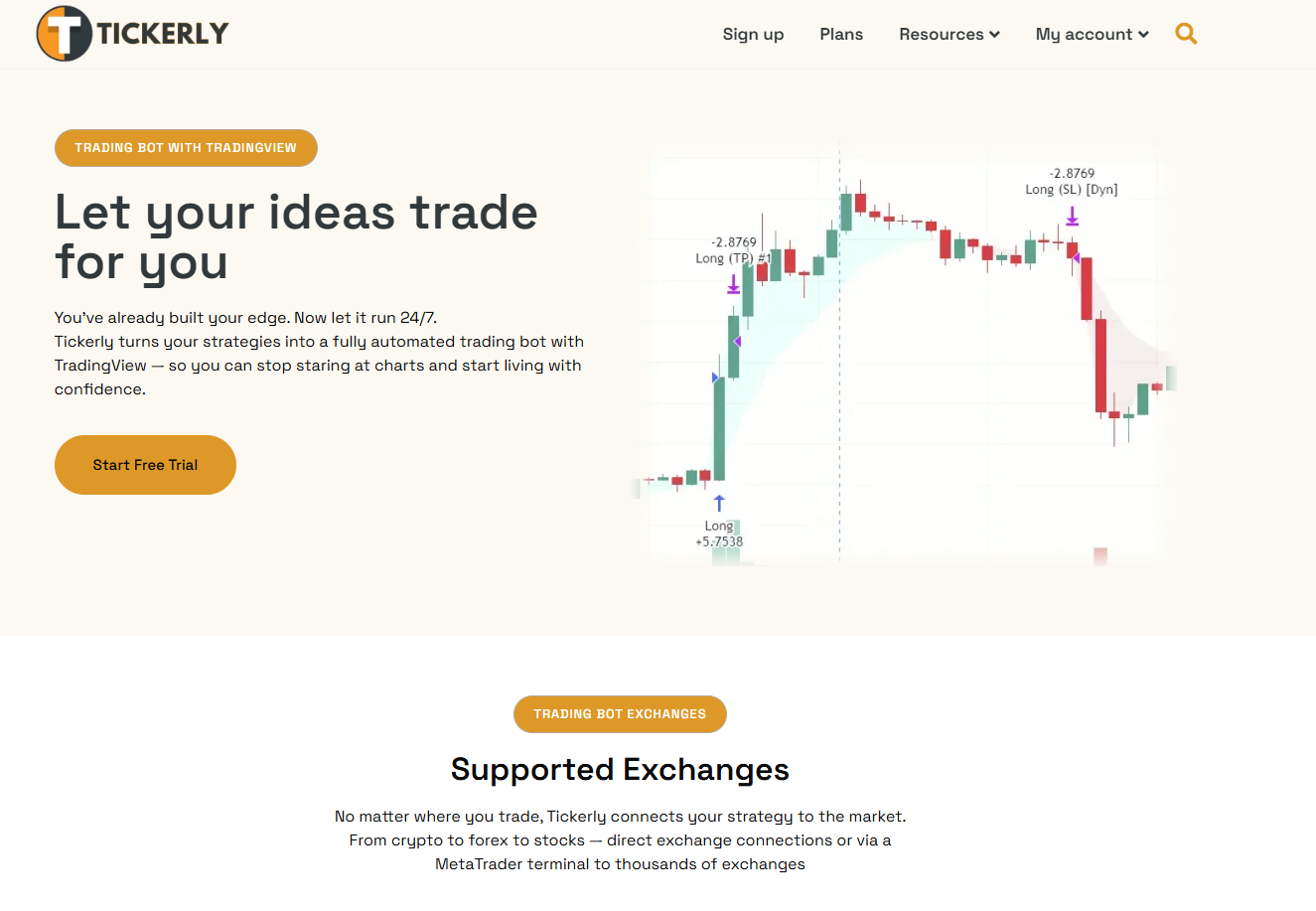
Tickerly’s plans scale with how you trade, with pricing and tier details available on the automated trading plans page.
Every plan starts with a 30-day free trial, so you can connect a real TradingView strategy and watch it execute before committing. Start your trial and see your first automated alert fire in real time.
FAQ
What Is the Most Successful Trading Bot?
There’s no single bot that qualifies as universally “most successful,” since success depends on whether you need execution, signal generation, or analysis automation. Tickerly is the strongest fit for traders who need a validated TradingView strategy executed with low latency, while Trade Ideas and TrendSpider serve different needs around scanning and technical automation.
Which AI Bot Is Best for Day Trading?
For active day traders who already trade off TradingView charts, Tickerly is built specifically for that workflow, offering no-code automation from alert to execution. Traders who want AI-generated trade ideas rather than execution of their own strategy tend to prefer Trade Ideas for its equities scanning engine.
Are Day Trading Bots Illegal?
Day trading bots themselves are legal tools when connected through legitimate exchange or broker APIs with proper permissions. The risk isn’t legality, it’s regulatory: the CFTC has warned that AI marketing claims for trading bots can be fraudulent, so verifying a vendor’s background before connecting live capital matters more than checking a legal box.
How Much Does Tickerly Cost?
Tickerly’s plans start at $19 per month for Level 2, scaling up to $29 for Level 3 and $39 for Level 4, with Level 4 Ultra for traders who need 2,500 alerts a day. Every tier includes a 30-day free trial before billing begins.
What Should I Ask Before Subscribing to a Trading Bot?
Ask for a timestamped, third-party-verified performance record rather than screenshots, and confirm the platform only requests read-only or trade-only API access, never withdrawal permissions. Also ask exactly which exchanges or brokers it integrates with and how its backtesting engine accounts for slippage and commissions.
Recommended
- Best Forex Trading Bots for 2026
- Best Crypto Trading Bots for Active Traders in 2026
- Best Stock Trading Bots for Automated Traders in 2026
- Checklist for Bot Setup: A Trader’s Complete Guide
This article was produced with Al assistance and reviewed for accuracy. It is provided for general information only and is not professional or financial advice.